Showing posts with label epic fantasy. Show all posts

Sunday, October 17, 2010

[Beyond the Wordcount] From Self-Published to Traditionally-Published by Todd Newton

Do you wonder how a book is made? If you are an avid reader and the sight of a book makes you glow, then you probably have wondered about a novel’s journey from idea to hard/softcover delight on your local bookstore’s shelf. Did the author discover the story whole and intact? Did the story need countless revisions? How much is researched and how much is the product of the author’s imagination? What did the author have to go through to publish that novel you just love? Beyond the Wordcount is the feature that will give a behind-the-scene look to the story behind the story, the things that you will never guess as they stay off the pages.

This week my guest is Todd Newton, author of The Ninth Avatar, which has gone through two prints already. First as a self-published novel and then as a traditionally published novel. It’s no secret that I didn’t receive the self-published edition very well [review], pointing out that there is potential in the book, but only after extensive editing. Now, I do have the edited and revised book, which I hope to review soon.

Bio: I was born in 1980, had an interesting upbringing (as I'm sure we all have), and rebelled as a teenager. I have since realized I was not the only person to do this (hence previous the parenthetical statement). After ten tumultuous years I barely remember, I moved to Denver, Colorado. Things have been different ever since.

Blurb:

When the slain march, prophecy will be fulfilled. The Ninth Avatar is coming. Wizards have wondered for generations when a human would ascend to become the Ninth Avatar, and what would happen when they did. Opinions differ, but the Ninth Pillar of Magic--that of Darkness--is feared by many whether they use magic or not. When Starka, an outcast priestess of the magic loathing Cathedrals of Myst, receives a prophecy heralding this ascension, a new force rises to threaten the entire known world. The Carrion army, a race of transformed humans bearing black horns and an unquenchable thirst for blood, destroys every city it comes across. Their leader, Zion, has only one goal: to become the living embodiment of magic that is the Ninth Avatar. Aiding Starka in her quest to halt this are DaVille, a mysterious warrior bent on killing the Carrion leader; Cairos, a wizard from the betrayed city of Illiadora; and Wan Du and Lady Mayrah, a man and woman from rival nations now decimated by the Carrion. Amidst all this turmoil, Wadam, a Cardinal of Starka's faith, seeks to seize control of Myst for himself and thereby subjugate the female leaders. With the world in peril Starka must find the means to prevent these things, or die trying.


The Task: I have asked Todd to tell me of his journey from the scorned self-published ‘author’ to a traditionally published one [and I put those quotation marks in jest]. What I received from Todd was his journey with The Ninth Avatar from its genesis to long path to publication.

---

The stigma of self-publishing may always exist, no matter how rational or logical of an argument you post on your blog. It is nigh on impossible to get attention (and, therefore, readers) for your self-published book. This is because the responsibility to create a quality product rests on the author’s shoulders, rather than someone with deeper pockets or a higher headcount. Frankly, if you’re not already well-known, no one has any reason to trust you.

The Ninth Avatar began as a plot for a “garage” video game project. Its first iteration was a meandering “story summary” lacking just about everything a real story needs. Many years and a lot of work later, I had a coherent and thoroughly-edited novel manuscript staring at me from the other side of the computer screen. I also had a stack of query rejections from agents and various publishers.

This is not a unique scenario, but neither is it one for which there are any easy answers. The obvious question was what to do next, and all the searching and reading I did led me nowhere. I knew I wanted to write more books, even had a second one well underway, but I had no idea what to do with this completed novel.

With the intention of “getting my name out there,” I self-published The Ninth Avatar through CreateSpace, Amazon’s Publish On Demand (POD) offering. This was a tremendous learning experience for me as far as book/cover design, manuscript formatting, and “copy” writing because I had to do it all myself. CreateSpace provided an Amazon page, which was advantageous, but my original goal still seemed beyond reach.

At the end of the day, the challenge of “how do I sell the book?” remained. Even blog-based book reviewers are loath to touch self-published books, and I know because I contacted many of them directly. Getting a reviewer to read a book (any book) is like asking someone to do a bit of overtime after working a double shift; it’s not that they don’t care, but rather that they already have a stack of titles begging for their attention. For readers it’s much the same, except that they carry no obligations toward books. Merely preferences.

So it went until my book had been available for about two months. A fellow writer informed me of Trapdoor Books, a new startup publisher based locally. I contacted the man in charge, sent him a copy of my book and, after some debate and discussion, Trapdoor acquired it to publish. Finally, I would have something larger than me to add credibility to my campaign.

The process The Ninth Avatar (and I) went through with Trapdoor could not have been more different than self-publishing. The contract and money, for starters, were new. I had no agent, so the process was quite streamlined. Of course, when the work truly began I was lucky enough to be involved in certain decisions such as the map, manuscript edits, cover art, etc. I’m told by many other authors, especially debut authors, that their hands are pried off the wheel at this point.

Regardless, the responsibility no longer sat fully on my shoulders. I was an employee now, rather than the owner & operator of The Ninth Avatar, Inc. I had someone to ask when I had questions or concerns, someone who knew the answers and solutions. I was no longer running the marathon with only a cheering section to back me up.

Of all the differences, the largest was working with others. An Editor, someone paid to read manuscripts and provide suggestions to improve them. A Book Designer, someone paid to know how to make the text look good on the page, and care about the resolution of cover images. A Publisher, someone as invested as I was, and who wanted to see my book succeed.

Eventually, the book was released with a new cover and design treatment as well as numerous edits to the text itself. Its success, of course, still relies upon all of you. It’s been a long journey, and The Ninth Avatar and I still have a quite a bit further to go.

Monday, September 13, 2010

Game of Thrones: 'Raven' Trailer and Teaser

Just before True Blood's season three finale aired HBO decided to surprise George R. R. Martin fans [who I am positive cannot wait for Spring 2011] with a brand new trailer and a teaser from the upcoming Game of Thrones TV series. Get them while they are hot, boys and girls. I will convert by reading the first novel in the Song of Fire and Ice, when season one launches. 


Sunday, May 16, 2010

REVIEW: The Adamantine Palace by Stephen Deas

Title: The Adamantine Palace
Author: Stephen Deas
Paperback: 369 pages
Publisher: Gollancz (19 Mar 2009)
ISBN-10: 0575083743
ISBN-13: 978-0575083745
Genre: Fantasy
Series: First in series
Reviewer: Cara
Copy: Bought myself

Synopsis:
There will be flames.

The power of the Realms depends on its dragons. Jealously guarded, nurtured by their handlers, ridden by the aristocracy, they are bred for hunting and for war. But only the alchemists and the mysterious liquid they administer to the dragons stand between the Realms and disaster; for without the liquid, the dragons would be returned to their natural fury: unbiddable, terrifying, awesomely strong, able to destroy an entire army, to burn a kingdom to ashes.

Prince Jehal is thinking of other things. Of power over all the Kings and Queens of the Realms; and he is prepared to charm, lie, betray, plot and murder to get it. Nor is he alone in his ambition. Queen Shezira has her daughters and she means to use them as she herself was used, to gain the ultimate prize, marrying them off to secure her influence and power.

All sell-sword Kemir is thinking of is money. Of freedom from the un-ending arrogance of the dragon riders. And maybe of a little cold revenge against the warlords who both need him and despise him.

And now a dragon has gone missing…


I have had a soft spot for dragons since first reading the Pern novels by Anne McCaffrey in the 1980’s so I picked up The Adamantine Palace based on the cover and blurb on the back. I was not disappointed. Indeed, for a debut novel, Stephen Deas has produced the fantasy equivalent of a blockbuster movie… impressive.

A blend of political intrigue and fiery action, The Adamantine Palace breathes new life into the dragon trope. Here we are introduced to dragons, their basic nature suppressed by alchemy and bred by the aristocracy for hunting and war. They are given as wedding gifts, viewed as status symbols and used to back up the political machinations of their owners. But when the white dragon, Snow, goes missing, she is no longer being given the alchemists’ potion and soon she is communicating telepathically with her minder, the Scales Kailin. She is fully sentient and aware of her true nature. She wants to free the rest of her kind from their oppression.

Prince Jehal is a minor Prince with grand aspirations. He plans to be Speaker of the Realms and will let nothing stand in the way of achieving his ambition. Like a renaissance Borgia, he plots and conspires, murders and poisons with charm and panache. He is an amoral playboy but also someone who held my interest from the prologue. His relationship with Zafir is a significant part of his powerplay, even though she is pursuing her own ambitious agenda. His only weakness would appear to be the unwelcome feelings that develop for his new wife, Lystra. The privileged lifestyle of the aristocracy, complete with the arrogance of long held political power and dominance over the dragons sets a scene where rebellion is ripe.

Being the first in a series, The Adamantine Palace introduces us to its world. While not overly descriptive, I found there is sufficient detail provided to allow my imagination to fill in any blanks. However, I would have liked to see a map, especially as there are various kingdoms and eyries mentioned throughout. The family trees were a helpful addition, given how many players there are in the court political arena. One interesting point, which I hope will be furthered in future books, is the role of the Taiytekei. We know they want a dragon hatchling of their own, and they are allied with Prince Jehal, but will they play a more prominent role at another stage?

But most of all I loved the dragons! As the effects of the liquid potion wear off Snow, a rare white dragon, begins to dream of how her kind were before the alchemists learned to tame them, she wants to free her species from the control of humans. She communicates telepathically with her human companions thus revealing her intelligence and her anger at what her fellow dragons have become... mere transport vehicles used for hunting and war but also as prized possessions to be distributed at the whim of the ruling elite. We also realise that the dragons, if weaned off the alchemical potion, could decimate the land and all the people within it.

The Adamantine Palace is an action packed read. Short chapters, with alternating points of view, set a cracking pace from the outset. The language is vibrant with dialogue that moves the story briskly along, yet revealing the levels of political machinations throughout. I would have liked some more background to the royal families, but this may be revealed later in the series, as the next book The King of Crags, refers to a royal that keeps himself hidden away from the other Realms. Certainly the scene is set for a sequel as there are several plotlines to carry over. I want to know what Jehal plans next and who will be left to oppose him. Will Snow continue with her mission to rescue the dragons from a half-lived existence among their human owners? I, for one, intend to find out very soon as The King of Crags has been published.

Rating 8/10

Saturday, February 27, 2010

[Review] 'Spellwright' by Blake Charlton

Title: Spellwright
Writer: Blake Charlton
Pages: 352
Genre: Epic Fantasy
Standalone/Series: First in The Spellwright Trilogy
Publisher: Tor Books

Nicodemus is a young, gifted wizard with a problem. Magic in his world requires the caster to create spells by writing out the text . . . but he has always been dyslexic, and thus has trouble casting even the simplest of spells. And his misspells could prove dangerous, even deadly, should he make a mistake in an important incantation.

Yet he has always felt that he is destined to be something more than a failed wizard. When a powerful, ancient evil begins a campaign of murder and disruption, Nicodemus starts to have disturbing dreams that lead him to believe that his misspelling could be the result of a curse. But before he can discover the truth about himself, he is attacked by an evil which has already claimed the lives of fellow wizards and has cast suspicion on his mentor. He must flee for his own life if he’s to find the true villain.

But more is at stake than his abilities. For the evil that has awakened is a power so dread and vast that if unleashed it will destroy Nicodemus... and the world.

‘Spellwright’ and Blake Charlton registered on my radar since August 2009. Given that Aidan from ‘A Dribble of Ink’ spent a series of posts dedicated to this debut’s path to publication, my interest intensified and with each new notification I began to anticipate March and read this book. Quite naturally, I jumped at the opportunity to read a ‘Spellwright’ ARC. I wasn’t disappointed and I am happy to report that the good rep given by several well-known authors is not artificial marketing hype. Quite the opposite. ‘Spellwright’ is my February’s top read and in my list of all-time favorites.

Although fantasy has adopted a violent, gritty mantle with almost irredeemable characters and exploration of the darkness, which lurks in the human soul, ‘Spellwright’ ploughs straight through well trodden paths and will ring a very nostalgic bell. The villains have no qualities to suggest any excuse for their actions and the protagonists are drawn and sworn to subdue the arising chaos. Lives are at stake. The world as it is known is threatened. There is a mission and prophecies, which will be fulfilled by a few destined ones. Sounds familiar in general, but rest assured that clichés associated with these fundamental for the genre tropes are not hiding in between the pages. It’s all a matter of execution and Charlton is a natural. His prose is a rare breed of scholarly sophistication and lyrical streaks, which grabs the mind, ensnares it and makes sure that the reader will keep reading.

The biggest delight in ‘Spellwright’, however, is the magic system. Fantasy without magic as an element would be crippled and in almost every magic system, language and words enable spellcasters to perform miracles or inflict pain. Charlton takes this basic trait of magic a step further and devices a world, where languages hold the power. Wizards are linguists, devoted to their studies. Each language follows a different logic, owns separate syntax, formulas and set of runes and serves a different purpose. So far in ‘Spellwright’ the reader is treated most to Magnus, a language with effects on the material, and Numinous, a language that affects light and energy. However, we are also introduced to other languages with other properties and other dimensions, because each spell must be cast from the spellcaster’s muscles and becomes both visible and corporeal.

With this I am just scratching the surface. There more evolved concepts such as constructs, which are sentient and complex spells with a shape and a function. Durable metaspells and powerful godspells. Quaternary thoughts, which enable a person to think unthinkable thoughts and the potential danger, when handling these languages. Precision and skill are required at all times or otherwise the spellwrights may end up hurting themselves with spells, which have exploded and backfired. There are no inconsistencies within this magic system, which is also a possibility due to the high complexity involved.

As drawbacks here, I would point out that the reader must be patient about explanations, regarding several spells or other ideas as far as magic and the history behind it is concerned. Because the story uses the Starhaven academy and the protagonists are academics, what they narrate about is known to them and unnecessary to explain, when it pops up. I had a few moments, where I had to use the logic within the world to piece what a spell’s purpose was, but explanations were provided at an appropriate moment for their justification. At the same time the reader must be patient with the stage-setting, explanatory paragraphs and the bits and pieces of information until the world becomes familiar enough, so that the action sequences do not raise eyebrows in confusion, when spells start flying around. I personally had no issues with any of this and welcomed the extensive world-building.

‘Spellwright’ is as much scholarly as it is dynamic. However, untypical for epic fantasy, the events in the novel transpire on Starhaven Academy’s grounds. There are no parties with the hard task to travel across the world. Nevertheless Starhaven’s massive size and labyrinthine architecture bring danger and the characters never know what they can expect from the halls and bridges, spanning from tower to tower. Speaking of the characters, I was intrigued by the majority of the characters, primary and secondary alike.

Nicodemius’ struggles with his condition to misspell magic texts are earnest and heartfelt. His soul is torn between the reality he has known that he is a retard in a world, where literacy is supreme, and the hope that perhaps he is not supposed to be cacographic, but whole. Normal and capable, not powerless. Not someone, who people look down upon. To a level everybody can relate to such an emotional turmoil and since Charlton himself is a dyslexic, the internal conflict about one’s worth packs a bigger punch, because it has been written by someone, who has first-hand experience. However, Nicodemius would not be as intriguing, if it were not for the blind Magister Agwu Shannon with a violent political past and his construct bird Azure, Amadi and her intrusive and authoritarian persona, Deirdre and her devotion and selflessness in order to please her goddess, Fellworth and his nefarious schemes, etc.

Perhaps, my only issue with ‘Spellwright’ is how the novel ended. While the culmination was spectacular and rich in revelations that foreshadow events to come, I would have preferred the novel ended there, while I was still high on the adrenaline and my interest was in my highest. However, the story continues well past that, covering Nicodemius’ training for the upcoming battles, which will define the world’s fate. I feel that this would have better fitted the sequel ‘Spellbound’, because it suggests a buildup for a new adventure.

Verdict: [A++] I am quite biased, when talking about this book. It appealed to me on so many levels to a point, where even if there are serious issues with ‘Spellwright’, I would never spot them. Charlton has converted a life-long fan in me and I am recommending ‘Spellwright’ left and right to everyone. Certainly a superior book and a promising debut, which most likely will result in a healthy and long-lived career.

Thursday, February 18, 2010

[Review] 'Nyphron Rising' by Michael J. Sullivan

Title: Nyphron Rising
Writer: Michael J. Sullivan
Pages: 362
Genre: Epic Fantasy
Standalone/Series: Third in The Riyria Revelations
Publisher: Ridan Publishing

A PUPPET IS CROWNED.THE TRUE HEIR REMAINS HIDDEN. A ROGUE'S SECRET COULD CHANGE EVERYTHING.

War has come to Melengar. To save her kingdom, Princess Arista runs a desperate gamble when she defies her brother and hires Royce and Hadrian for a dangerous mission. As the power of the Nyphron Empire grows, so does Royce's suspicion that the wizard Esrahaddon is using the thieves as pawns in his own game. To find the truth, he must unravel the secret of Hadrian's past...what he discovers could change the future for all of Elan.

Where ‘The Crown Conspiracy’ and ‘Avempartha’ read as standalones ‘Nyphron Rising’ would be a great deal of a challenge, if the reader has not invested the time and resources to read the first two installments in the Riyria Revelations. Events are tied and the actions along with the consequences they spawn will shape the course for the characters in the upcoming installment, which I am oh-so-anticipating to read. As the natural halfway-point for this six volumes series, ‘Nyphron Rising’ is a middle book and as such its major storylines do not resolve, instead set the stage for the culmination in the soon to follow novels in the series.

To further back up my claim the storylines do not seek a way to collide into each other and run neck to neck with any visible connection. On one hand we follow the coronation of Thrace as Empress and the resurrection of the Empire, now that the heir has presumably been found. However, the reader’s shown the heart of the Empire and its true face, which is not something pretty. As far as I grasp it, the very first incarnation of the Empire served to the well-being and the unity of its subjects against the dangers that were the other races in the past. This incarnation is more about greed and the ambition of cunning with their schemes to own, to have, to restore and rule what they think is entitled to them. The clergy it would seem is not so innocent or pure, especially master Machiavellian character, bishop Saldur, now pronounced as regent to the Empire. To emphasize how cold-hearted the men running the Empire are, we witness the de-humanizing treatment Thrace, now named Modina, receives. It was an interesting inside look into the relationship between Amilia and Modina, given the fact that the Empress suffers from detachment from the real world and is practically mute.

The other storyline is more dynamic and action packed, following princess Arista as she tries to prove her worth to her brother and her usefulness to Melegar, which is now at war with the Empire and not doing an admirable job, due to the lack of support from other kingdoms. The manner she chooses to do that is by hiring the Riyria and go on an almost suicide mission to strike a treaty with the nationalists. On the outside the storyline provides dealings with dubious characters, they face betrayal and they get caught in an uprising, organized and executed by Arista herself in Ratibor. However, on the inside this is a profound character study and development. It seems to be the heart of ‘Nyphron Rising’ as we see key characters learn more about themselves and solve dilemmas.

The biggest surprise was the focus on Arista’s development from spoiled royalty to an actual human individual, who is touch with the people and not separated by ranks and hierarchy. At first it was tedious to read her narrative, because I dislike such characters, but her development after Sullivan pushed her hard outside her comfort zone was one to behold. One could say she has become a woman in her own right and a witch in the more capable and resourceful sense, although there is some slight foreshadowing that he might wrestle with desire and temptation to use her powers to full extent. In the mean time Hadrian and Royce have some issues to work out as well. Hadrian suffers from depression and existential crisis, trying to find his vocation or at least something honorable to pursue, while Royce has hesitations, whether or not to leave his friend pursue his destiny. The rocky terrain their partnership endures through a new angle to look at the characters and that paired with the mission to track down the true heir to the Empire and decipher the games of the ancient wizard Esrahaddon makes ‘Nyphron Rising’ an interesting read.

Verdict: [B+] Despite the intrigue, the mystery and the ancient secrets that piece together a larger and impressive in itself picture, ‘Nyphron Rising’ didn’t quite do it for me. In comparison to the first two installments it pales a bit, but I can justify that with the natural need to have a book that prepares the chess board for the upcoming game in the world of Elan. Nevertheless, Michael J. Sullivan has carved his name in the genre and I am only sorry that he is seriously under-read.

Tuesday, February 16, 2010

[Review] 'Avempartha' by Michael J. Sullivan

Title: Avempartha
Writer: Michael J. Sullivan
Pages: 344
Genre: Epic Fantasy
Standalone/Series: Second in The Riyria Revelations
Publisher: Ridan Publishing

When a destitute young woman hires two thieves to help save her remote village from nocturnal attacks, they are drawn into the schemes of the wizard Esrahaddon. While Royce struggles to breech the secrets of an ancient elven tower, Hadrian attempts to rally the villagers to defend themselves against an unseen killer. What begins with the simple theft of a sword places the two thieves at the center of a firestorm — that could change the future of Elan.

To cite Bogart’s transcending-time line from Casablanca: ‘This could be the beginning of a beautiful friendship’. I share the same sentiment towards the Riyria Revelations by Michael J. Sullivan. ‘The Crown Conspiracy’ opened my February reading with a bang and I conceived high expectations that ‘Avempartha’ would be just as good and hopefully even better. Perhaps there was slight hesitation on my part, caused by the chance that maybe the promise in book one remains a promise and that ‘Avempartha’ would suffer from the second child syndrome. But from the breathtaking cover [done by the author himself] to the last page, ‘Avempartha’ reached and surpassed all hopes and extinguished all fears.

Standing at 344 pages [according to Amazon; my edition has 321 or so] ‘Avempartha’ offers an adventurous two-day trip through the lands of Elan, escorted by your intrepid duo and their royal contacts. Despite being a second novel, ‘Avempartha’ can be read as a standalone with no discomfort on the reader’s part. It shares several similarities with ‘The Crown Conspiracy’ in the sense that both novels follow the model: heavy stage setting, followed by adrenaline packed resolution. Also the loose ties between the volumes contribute to the illusion that ‘Avempartha’ could be a series opener.

In ‘Avempartha’ we find our intrepid duo Hadrian Blackwater and Royce Melborn on a brand assignment in the village of Dahlgren. The storyline picks up in the trading center of Colnora, where a distressed Thrace hires Riyria for a deceptively simple task, which as the story gains momentum gains greater importance and a dangerous edge. For Dahlgren is a terrorized by a beast from the wars between the elves and the humans 900 years ago. The Gilarabrywn is pure, predatory magic and each night eats a member from the Dahlgren community, which is revealed to break an ancient human-elvish peace treaty. The second storyline follows princess Arista’s life as a newly appointed ambassador to the kingdom of Melegar, now under the rule of her brother Alric. Melegar is still unsettled and Arista’s new function and acclimatization to the events following the murder of father become complicated as she bears the stain of witchcraft. In the mean time the Church of Nyphron shows interest in her as a possible pawn in their schemes and Arista is left with a moral dilemma. Two different in nature storylines entwine into one as Arista and the Church of Nyphron arrive in Dahlgren along with a larger number of strong-bodied men, both common folk and nobility, for a contest, which leads to many deaths and destruction.

I was impressed at how effortlessly both plots flowed into the big resolution, which concluded the novel with a daring well-orchestrated finale. If you think that ‘The Crown Conspiracy’ has daring escapades, then you will be highly entertained to see the struggle between the Riyria, the Dahlgren community and the Nyphron Church all together against the Gilarabrywn, which apart from being a deadly beast is also cunning, malicious and scheming. Hadrian has to face his greatest combat adversary in the Gilarabrywn, while Royce has to pick his toughest lock, yet. The stakes are high, the adrenaline pumping and anticipation soaring. As a treat in the end of the book, the reader is fed juicy details about both Hadrian and Royce’s origins, which are left as seeds for further volumes. At the same time the intrigue is also taken one level higher with the Church of Nyphron’s plans to raise a puppet emperor. Bishop Saldur is the kind of villain I love to read about and to hate, really, but his schemes and masterful orchestrations give me goose bumps and have me wondering how well he has plotted his success.

I established that the story is brilliant, the cast endearing and engaging, but ‘Avempartha’ is a testament to world building and infusing setting with some divine breath. Apart from showing the reader the lives, the strife and the mentality of the royalty, Sullivan manages to give the common folk their due in ‘Avempartha’. Dahlgren has become an inviting village I would only hope to visit in my dreams with a modest accommodation, but with honest, welcoming community. The reader can feel the small village’s pulse. All of this is organic to the story’s fabric. Sullivan also manages to color of Elan through Esra’s recollection of the elves, the wars and the purpose of the mystical and inaccessible tower of Avempartha. All information comes at even intervals similar to tides and avoids becoming tedious info dumps, but instead a hook to keep the pages turning.

Verdict: [A+] Sullivan brings out the very best in the genres, dishes it out skillfully and with artistry in a compact book, which will ensure an unforgettable and infectious reading experience. I am beyond contempt with how the Riyria Revelations are turning out. Highly recommended.

Friday, February 12, 2010

[Review] 'The Crown Conspiracy' by Michael J. Sullivan

Title: The Crown Conspiracy
Writer: Michael J. Sullivan
Pages: 296
Genre: Epic Fantasy
Standalone/Series: First in The Riyria Revelations
Publisher: Ridan Publishing

There's no ancient evil to defeat, no orphan destined for greatness, just two guys in the wrong place at the wrong time...Royce Melborn, a skilled thief, and his mercenary partner, Hadrian Blackwater make a profitable living carrying out dangerous assignments for conspiring nobles until they become the unwitting scapegoats in a plot to murder the king. Sentenced to death, they have only one way out...and so begins this epic tale of treachery and adventure, sword fighting and magic, myth and legend.

‘The Crown Conspiracy’ has been in the review bloggers’ mouths for quite some time and it comes highly recommended from people, who have a sharpened sense for quality and spot gold, when they see it. I have to chime in the choir and sing some praise of my own. ‘The Crown Conspiracy’ distinguishes itself from the flock with a self-contained plot and major threads wrapped in the end of the story. Just shy from 300 pages, it offers a quick reading experience. All untypical traits for epic fantasy, which is more or less known for mammoth volumes as well as epic story arcs, secondary plots and cast of innumerous characters. ‘The Crown Conspiracy’ relies on a fast pace, dynamic situations, a tight, well groomed story and a limited number of character POVs. These choices eliminate pacing issues and confusion that may arise from abundance of characters and secondary plots. Simplicity here is a virtue.

However, being modest and restrained does not translate to a flat and underdeveloped book. On the contrary, ‘The Crown Conspiracy’ exemplifies a multidimensional and a well-crafted novel. I particularly enjoyed the secondary world of Elan, which is so Earth-like and yet so different from our own. As I stated earlier in my post about my first impressions, I loved the parallel between the Novronian Empire and the Roman Empire, but not in any recognizable historic sense. There is a loss of culture and degradation of the collective memory as secrets, knowledge and techniques fade to nothing in the troubled warring times, where the remnants of the empire fight each other to establish sovereign kingdoms. Magic, the Art, as a collective symbol of the era is also forgotten and shunned. What was once thriving now lays in decay. Again, not uncommon for this genre, but Sullivan builds his world with conviction and through his characters’ and narrative it transforms into an actual destination in the reader’s mind. When that transpires, I say, the author has done his job well.

On to the story itself, then. As stated in the title, there’s a conspiracy. The king of Melegar has been murdered and nobody has an idea, who the culprit is. My congratulations go to Sullivan for stretching the mystery as far as possible and keep me guessing for good, before he let the cat out of the bag himself. Sullivan provided several dastardly constructed red herrings and I alternated between princess Arista and her uncle Percy Braga. Could I trust the cultural stereotype that condemns all magic practinioners as vile and scheming characters, disguised as innocents, and accuse Arista? Or is the devoted and loyal Uncle Percy Braga ruled by greed and lust for power, thus deserving my pointing finger? Whatever my own suspcisons were the actual purpose behind this assassination is much more thrilling and complicated, which is the seed, the readers will see grow in the following installments.

Last, but not least I will discuss characterization, which paired with the solid worldbuilding made this book a page turner. Hadrian Blackwater and Royce Melborn are the mercenary duo to entertain you through this epic journey through Melegar and they do a splendid job at that as well. Hadrian is the good-hearted part in the team, while Royce is the designated sullen and brooding character. Both have mysterious pasts, but the author does not rush to reveal them just yet, since this book is more about Arista and Alric. The duo’s dynamics are handled with a careful hand, provide solid entertainment and it’s impossible not to become attached to both. It is a safe bet that there is an epic bromance to be found here that can be achieved only between fleshed out characters. There is much about Hadrian and Royce that keeps the reader wanting more. On several instances they have made noble gestures, which then have been explained with ulterior motives, thus staying true to their outlaw nature. This is the reason I believe that the characterization is top notch. The characters’ justification behind each action. Fifty pages in, and you will learn that not a single action by the key players is done without a clear concept and purpose.

Now, you probably believe that there is nothing wrong with this novel. I wish it was so, but as with all things man made, there are a few faults here and there, which in this case are based on my own personal preferences. I believe it clever to use Myron, the bookworm monk, as a device to fill in necessary chunks of information regarding the world, the religion and the history of the lands, but his help has been a bit too convenient. It felt to me at times [not all the time, mind you] that his sole purpose in the novel was to help speed the quest and offer opportunities, when a dead end pops up. Thankfully, his personal tragedy and background prevent him from being a cardboard copy and a device. I also did not like the spoilt crowned prince grow from pampered to a man, especially one fit to rule the kingdom. However, this is a trope I personally detest and no matter how well done [it has been formidably done here] I never take to it. Apart from these minor issues is nothing left to be pricky about. It is a bloody good book.

Verdict: [B+] ‘The Crown Conspiracy’ is different, which will certainly attract the long term fans, while at the same time, this is a great introductory novel for those, who wish to taste epic fantasy, but the usual hefty volumes discourage them. A light-spirited and exciting debut. I can only recommend this novel.

Sunday, November 8, 2009

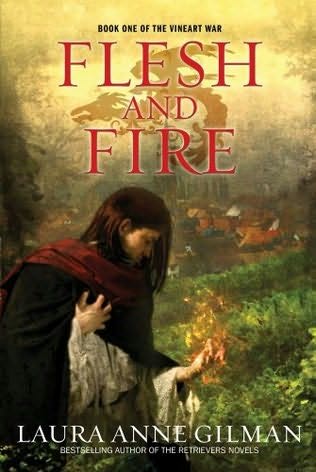
"Flesh and Fire" by Laura Anne Gilman


Title: "Flesh and Fire"
Author: Laura Anne Gilman
Pages: 384
Genre: Epic Fantasy
Standalone/Series: First novel in the "Vineart War" series
Publisher: Pocket Books

My copy came courtesy of Pocket Books and I should have posted my review a week or so ago to be in synchrony with the promotional book tour. To think that I wanted to drop this as pick from Pocket, because I felt overworked. It seems surreal, now that I have read this novel and consider not reading it a great intellectual robbery.

Fourteen centuries ago, all power was held by the prince-mages, who alone could craft the spell-wines. But the people revolted against harsh rule, and were saved by a demigod called Sin-Washer, who broke the First Vine, shattering the hold of the prince-mages.

In 1378 ASW, princes still rule, but Vinearts now make spellwines, less powerful than in days of old. Jerzy, a young slave, has just begun his studies to become a Vineart when his master uncovers the first stirrings of a plot to finish the work Sin-Washer began, and shatter the remains of the Vine forever. Only his master believes the magnitude and danger of this plot. And only Jerzy has the ability to stop it…before there are no more Vinearts left at all.


Cover art and book blurb have hinted that this will be the beginning of yet another medieval fantasy series, which will explore yet again the coming of age theme. What can be so different from all the other books under the same lid? Oh, everything. From the magic system, which has cemented my conviction that fantasy knows no bounds, to the unorthodox handling of the coming of age trope this novel is as refined as any French vintage year. I couldn’t find a fault anywhere within this story and I usually refrain from being too emotional about a book, but I can’t help myself with “Flesh and Fire”.

This idea could have flopped in so many aspects, if it was handled by an emerging author, so I am thankful for Gilman for pursuing it after being so successful with her urban fantasy series. With that out of the system, let’s look at the characters. For starters the cast is abundant and I can safely say that each human being that appears on the pages at any given time is a living, breathing person. This is rare. This is the magic. Even when nothing of interest happened the figures entertained me with their personalities.

And Gilman has brought to life intelligent and prone to get into verbal battles characters. Conversation, this back and forth connection between Master Malech and his student and formal slave Jerzy, is the primal tool for setting the rules of the world, the magic and the mythology. Malech is a strict, fair and generous teacher and Jerzy is a cautious, willing to learn and taking responsibility student, who wants to excel and prove his master right by picking him as a student. Then the reader is offered the color that is the secondary cast from the respect inducing housekeeper Detta, Jerzy’s fighting teacher Cai, the odd and eccentric Vineart Giordan, the honorable mistress Mahault, the sly mouthed trader Ao and many more.

The characters set in this exotic and yet familiar world embark on a journey, which starts as a relaxed stroll on a cobbled path amidst a garden and then winds, widens, hardens and crosses streets and roads until the reader finds that from a rather placid beginning his breath is stolen by the suspense at the near end. For the sake of experiencing this story I will not mention any concrete details, but I just enjoyed how the level of difficulty for these people went up by a notch with the transition from each part. In part one, “Slave” the reader is introduced to world and cast. Horizons are restricted solely to the Malech House. Part two, “Student” broadens the borders, shows what happens outside, continues supplying new information about the magic of this land. Rumors about bad omens are just a whisper. Part three “Spy”, has the reader know that something is wrong and Jerzy is wading into dangerous waters with unwritten rules with an ending, which is by no means a cliff hanger, but has made the reader physically crave the next installment.

There are a few books that truly sweep me off my feet. There are even fewer that re-spark the flame and makes me remember, why I want to be a writer. And there is tiny percentage that has truly changed my inner world completely. “Flesh and Fire” did this for me. It’s individual for everybody, but I highly doubt anybody not liking this novel.

Wednesday, September 30, 2009

"The Swordbearer" by Glen Cook [Reviewed by Peter Dowd]


Up for review is Glen Cook’s, The Swordbearer. This is a stand-alone work recently re-released by Night Shade Books with some terrific cover art by Raymond Swanland. This is a classic coming of age story with some of the usual suspects as story elements. Yet, Cook gets better mileage out of it than most.

The story’s protagonist, Gathrid, is the youngest son of a minor noble. Stuck by polio in his youth, Gathrid has a limp and general numbness on the left side of his body. As a result, he is set aside and “protected.” When an armed conflict arrives on his front door, he sent away into the woods with the women. He never quite makes it, but hides amid the ruins of his family’s estate. Later, escaping one of the twelve Toal (i.e. the love children of Ringwraiths and Sith lords), Gathrid takes shelter in a cave wherein he finds a large coffin guarded by an ancient sleeping dwarf. Glancing into the coffin, Gathrid lays eyes on the ancient sword Daubendiek. Unable to resist, Gathrid grabs the sword and, upon so doing, the ancient dwarf awakens saying, “Suchara has chosen.” Is this a bad thing? Perhaps, but any further on and you’re in for some spoilers.

Suchara is an ancient god-like being who is actually sleeping. So are her husband and two children. The four of them, in dream states, rip at the lives of people in the world of The Swordbearer without any real awareness of the damage being done. The sword, Daubendiek, is a sword that operates on something of a vampiric mechanism. The sword consumes the soul of the individual it kills, transferring the knowledge and awareness of the individual into the Swordbearer. However, the bloodthirsty weapon has something of a mind of it’s own. On occasion, it will co-opt the use of its wielder’s body and strike out at anything on two legs within arm’s reach. Daubendiek is actually a tool used by Suchara to possess and control a Swordbearer. Yet, Suchara always has her servant, Theis Rogala, nearby. It is rumored that, at an appointed time, the ancient dwarf ends the lives of each Swordbearer with a dagger of his own.

Needless to say, the title of Swordbearer is something that isn’t as great as it sounds to most boys/young men. Gathrid, unlike previous Swordbearers, travels a slightly different path, as he strives to be free of Daubendiek, Suchara and Theis Rogala.

The Bad: The convolutions towards the end of the tale. The story attempts to get too clever, or too surprising. The tale attempts to maneuver the reader into a position of suspicion vis-à-vis each of the characters motives towards the protagonist. It seemed to be a lot of unnecessary motion, flailing, and floundering heat loss. That having been said, it was the only element of the book that I didn’t favor.

The Good: Everything else. Seriously, if you have read Glen Cook before, this is more of that. Cook’s dialogue, prose and/or narrative is always ‘no-frills.’ This trade paperback, in fairly large font print, was approximately 250 pages. I am certain that, with any other author, it would have been between 450 and 550 pages. If you enjoy classic elements of heroic fantasy fiction, or the good old hack ‘n slash, then this is for you. It’s a brief and fulfilling ride through some familiar territory.

Rated: 8.25/10 (which means “for fans of the genre,” or at least this is how the ubiquitously absent roll – know what I’m sayin’?)

Afterword: Peter William Dowd is the owner of "Ubiquitous Absence", a blog, which chronicles his reads in fantasy.

Saturday, September 5, 2009

"The Ninth Avatar" by Todd Newton

Title: "The Ninth Avatar"
Author: Todd Newton
Pages: 452
Format: Novel
Genre: Epic Fantasy, Sword & Sorcery
Standalone/Series: Standalone as far as I can tell, but a hint towards a possible sequel and a prequel
Publisher: CreateSpace

What you can expect: A self-published novel, which breaks up the norm by combining aspects of sword & sorcery, epic fantasy and a hack & slash game atmosphere, but greatly suffering in execution.

Pros: I found the cast engaging at large, the setting to be up to my liking and the action to be addictive, while at the same time finding subtle messages about life, humanity and relations.

Cons: Although dynamic and thought provoking at moments, there is a flaw that can’t be overlooked in every category from characterization to pacing, from dialogue to prose.

Summary:
For Starka, an outcast accused of incest, life is about as simple as one could hope. A prophecy of the ascension of the Avatar of Darkness changed that. Starka, protected by the mysterious warrior DaVille, tries desperately to prevent the disturbing prophecy from becoming a reality. The world is thrown into chaos as the Carrion Army comes to power, destroying the rival nations of Brong and Rochelle. Wan Du and Mayrah are drawn into the conflict when their homes are destroyed and Cairos, a wizard from the betrayed city of Illiadora, likewise seeks revenge for his fallen comrades. As the leader of the Carrion army seeks to cover the world in death and darkness to become a living embodiment of magic, these uncertain allies battle against an inevitable conclusion. The Ninth Avatar is coming.


Foreword: To those reading Temple Library Reviews more closely and misfortunate enough to have conversed with me know that I am a complete oddball. My fascination with zombies and cult worship of Tori Amos’ music should be indication enough. As such I have strange preferences and an unlikely combination of factors can and will hold my attention for a novel despite a large array of flaws. Call it literary self mutilation. This is the case with “The Ninth Avatar”, a novel with countless good kernels of ideas, which never turned out to be a good crop. Partially I blame this to the fact that via self-publishing venues the novel never got the chance to be professionally edited and whipped up in a decent shape. The rest goes down to the author, who is still developing his voice as well as his conscious choice to write a novel that in a trilogy. Despite this there are redeeming qualities that held my oddballish interest.

Characters: “The Ninth Avatar” relies on a heavy cast of narrative characters coming to the total number of eight. We have everything from protagonists to antagonists and villains, from warriors and generals to priests and wizards. The usual difficulties with managing such a cast are evident as in transition from character to character, the establishment of distinct voices and having enough chapter time to give sufficient background, understand their motives and motivations.

However dialogue here is the main issue. Conversations are held in a tone and manner with expressions that shouldn’t be found in a novel set in a medieval world. It bugged me, because it destroyed the atmosphere and jarred me, preventing me from getting deep into the story. I couldn’t bear the chapters with the Carrion generals, where their inner fight for power and position in front of their leader Zion took place or Zion as a whole, who comes off as a card board cop of dark overlords. Most intense conversations that should strike a chord with me flopped and that worked against the novel in general.

Despite that Newton tries his best to present the readers with a diverse and engaging cast. I found Starka’s naivety and childish purity earnest and entertaining, while her awakening to the real face of the world that is startlingly different from the image created by her culture to be satisfying. Cardinal Wadam, although unlikeable as a character, stands as a fully developed antagonist enveloped in his own pride and overestimated self worth as the self proclaimed Mouth of Myst.

DaVille is another character I enjoyed, for he is the fantasy version of a movie star. He is tall, mysterious and dangerous, with fighting prowess that defies all odds and cold calculated wits. The nature of his relationship with Starka thankfully doesn’t exceed the limits of a strange friendship forged by chance and filled with some kind of romantic tension. To me this was a very positive decision. In the bad boy and conflicted categories we also find Carios, a guilt ridden wizard on a quest to make amends with his conscious, who isn’t afraid to use whatever is necessary to achieve his goal.

But I would have liked to see these characters developed in greater detail. I couldn’t sense the moment Stark grew from timid to confident enough to return to her homeland and try to mend the wounds delivered to her people. I wished I knew more about DaVille to explain to myself his reasons to accept Zion’s dark gift.

The Story: “The Ninth Avatar” is a hybrid between sword & sorcery and epic fantasy, but even though it hosts an interesting mix of both genres, it suffers in the identity department. I am not very well versed in both genres and my short term memory certainly doesn’t aid me in this manner, but I always connected epic fantasy with a massive scale operation, nations at war, military strategies and well planed battles featuring vast armies, diplomacy and royalty. These stories grow and unwind slowly like a trudging beast, a dragon slowly ascending to the upper world shaking century’s old sleep and spreading slowly his wings and taking flight.

“The Ninth Avatar” read like a flush flood injected into a vein, rushing, erratic and missing cues. Plot threats are being ignored. The military aspect felt underdeveloped at large. After a certain page the war falls into the background with little matter. Wan Du and Mayrah’s arc and their sabotage operations muster no reaction from the enemy. I felt like the novel could benefit more without these two characters and their stories, securing more pages for a smaller cast that could have been better explored and a tighter story. Although the focus goes off to the revolution in Starka’s homeland and the impassiveness of the city of Flaem and large Carrion armies sweeping through the whole world, it’s all just background music to me. At the same time “The Ninth Avatar” can’t be called sword and sorcery, because the battles here aren’t personal, they are in the name for the greater good, for saving the world.

Be as it is, “The Ninth Avatar” offers a fresh new world, which doesn’t use common tropes such as the inclusion of dwarves and elves, although dragons and gargoyles do appear. He also draws successful parallels between his world and our own, showed in the culture and mutual self-exclusiveness portrayed in the behavior of different lands. In the lands of Myst, those not under the service of the holy trinity are lesser humans, heathens and savages, while anywhere else these religious people are looked down upon and unfavorable for their preachy predisposition. Brong and Rochelle are excellent examples of age long enemies, fighting for territory and for pride, but when the cost is too high at the end, only then do the survivors question their actions and power struggles.

The world fascinated me enough. Since the novel was aspired from a computer game project, the magic, creatures and enemy are more or less prototypes for a hack and slash title rather than those used in the genres. The creative freedom left to wizards to invent new spells, limited to their ingenuity and the nature of the nine pillars, one governing aspects of the world such as life, speech, action, change and secrets. This leaves so much room for exploration and the potential to be surprised at every moment by a wizard, although it also leaves the gates wide open for dues ex machine to pop up, which thankfully doesn’t happen. There are also a special breed of wizards, who all share an above average level of power and brought some really memorable scenes near the climax. I enjoyed the battle scenes that really toyed pushed the boundaries of believability, but as an anime fan I was ecstatic. Magic swords are still one of the things although used in novels to death are still a fun thing to enjoy.

The Verdict: “The Ninth Avatar” could have evolved nicely into a better novel, if the author had started a trilogy and this was the middle novel as well as if Newton had more novels under the belt to bring this complex creation to life.

Rating: 2/5

Wednesday, August 12, 2009

"The Light Of Burning Shadows" by Chris Evans

Title: "The Light of Burning Shadows"
Author: Chris Evans
Pages: 384 hard copy
Genre: Epic/Military Fantasy
Standalone/Series: Book Two of the Iron Elves
Publisher: Pocket Books

What you can expect: “The Light of Burning Shadows” manages to keep up with the buzzed up enthusiasm that “A Darkness Forged in Fire” ignited in me as a reader and elevated the world and the bigger story to further, epic scales.

Pros: As the Calahrian Empire’s military force reaches to the far away corners of its territory the reader is introduced to more of the same haunting world building. New ancient forces are introduced and several characters take an interesting turn in their development.

Cons: My curiosity regarding the further enriched world remains unsatisfied and I feel that I have to interrogate the author to extract what I need.


Summary: "They might be doomed, damned, and buggered for all eternity, but that didn't mean they couldn't sparkle like a diamond in the sun and grin like a skull in the moonlight on their way to oblivion."

Musket and cannon, bow and arrow, and magic and diplomacy vie for supremacy once again in this second epic fantasy adventure from acclaimed author Chris Evans. As the human-dominated Calahrian Empire struggles to maintain its hold on power in the face of armed rebellion from within, the Iron Elves' perilous quest to defeat the power-hungry elf witch, the Shadow Monarch, takes on greater urgency.

The Iron Elves, shunned by their own people for bearing the mark of the Shadow Monarch, and desperately wanting to forever erase this shame, became legendary for their prowess on the battlefield as the Calahrian Imperial Army's elite shock troops. But when their commanding officer, Konowa Swift Dragon, murdered the Viceroy of Elfkyna, he was exiled, and these brave elves were banished to a remote desert outpost, doomed and leaderless, their honor in tatters.
Recalled to duty to reform his regiment from the dregs of the Imperial Army, Konowa thwarted the plans of the Shadow Monarch at the Battle of Luuguth Jor -- ensuring that the fabled Red Star, a source of great natural energy, did not fall into Her hands. Now Konowa must cross storm-tossed seas to seek out the lost elves and the prophesied return of another Star somewhere in a desert wasteland roiling with mysterious power, infernos of swirling magic, and legends brought back to life in new and terrible ways. And the fate of every living creature will come to depend on a small band of ragged and desperate soldiers, whose very loyalty to the Empire they have sworn to serve is no longer certain. When death is but a temporary condition, a terrifying question arises: who is the true ally -- and fearsome enemy -- in a growing conflict that threatens all?

Characters: Reading the second installment in this series clarified a few things that puzzled me regarding “A Darkness Forged in Fire” and characterization.

First, this is a series, which is story-driven rather than character-driven and as such the level of characterization is of an acceptable degree, by which I mean that one can overlook the sparse details concerning key figures. Second, Evans uses POV characters as observational tools to showcase the strengths and diverse personal traits of his secondary cast. Ample examples here include Yimt Arkhorn and Rallie Synjyn, who in the sequel more levels than I anticipated and their unmasking so to say is revelaed through the narratives of Alwyn Renwar and Visyna Tekoy. It’s a unique approach that surprised me completely and added a very distinct sub-flavor to the entire story.

This being covered I also enjoyed the development in some of the lead characters and their importance to the story. As “The Light of Burning Shadows” developed Konowa stepped down and the weight of the story was carried off to Alwyn Renwar. As the sole elf in the regiment, marked by the Shadow Monarch and responsible for the curse upon the newest incarnation of Iron Elves, I expected him central to further installments. In terms of using the frost fire, the magic tied to it and communicating with the Darkly Departed, the part of the regiment made from the ghosts of the dead Iron Elves, Alwyn excels with an uncanny ease.

I can only speculate where Evans plans to steer the story to after the cliffhanger ending and who will grow to be the power juggernaut, which is perhaps the best quality, regarding his characters. In critical moments, which, clichéd as it sounds, are of the life and death variety, each figure can surprise with unsuspected qualities, woven organically within the plot.

Story: Apart from growth in scale and acceleration in pace, “The Light of Burning Shadows” does not offer a different breed of story. I find this relaxing as I immediately feel at home with its rhythm and can predict what is to come. Personally I don’t mind the repetition in the story formula as long as the novel doesn’t claim otherwise. Plus what we have is a military story and in times of invasion and war, regiments are assigned a mission. Regiments head towards their designated target, fight the enemy and return victoriously or die. It’s what happens in the real world and as such is ought to happen in this series as well.

Unsurprisingly, it was world building, which won me over completely once again. I couldn’t imagine frost fire being countered, until the ancient power of the desert manifested through the white fire came into play. As a quest destination the desert seems an ageless classic and I instantly recalled all the Arabic fairytales I read as a child as well as the mystifying and adventurous atmosphere of Disney’s Aladdin. Reading about a swallowed in the sands library of power, dragonish beasts breathing fire in the dunes as well as skeletal soldiers subjugated to a mad mage returned the spark to my imagination once again. From a rather enthusiastic standpoint when it comes to world building I’m excited to read that magic branches, although not structured, clarified and explained, spring from the different regions of the land such as the desert in this case or the Shadow Mountain as the case with the frost fire is. From my reading experience power from the land is not uncommon, but not represented in such a rendition.

The Verdict: It’s a must-read. “A Darkness Forged in Fire” hooked me entirely and “The Light of Burning Shadows” only cemented my opinion that the Iron Elves series has been a wise reading decision

Monday, August 10, 2009

"A Darkness Forged in Fire" by Chris Evans

Title: "A Darkness Forged in Fire"
Author: Chris Evans
Pages: 615 soft copy
Genre: Epic/Military Fantasy
Standalone/Series: Book One of the Iron Elves
Publisher: Pocket Books

What can you expect: I can state with a great deal of personal conviction that “A Darkness Forged in Fire” is a strong and stable debut, which is a seldom find. Bordering between traditional fantasy, which is centered on a quest and the greater balance between good and evil, and military fiction as a hybrid it can easily secure a mixed audience.

Pros: Straight-forward and dynamic story, which is a fine break from winding plot lines caught in a maze. Unconventional portrayal of decades old cannons in fantasy literature. Good natured and organically tied humor to both story and dialogue.

Cons: The author’s attempt to veil the characters’ and world’s more interest-gauging details and aspects hinders the introductory purpose of a first novel in a series. As a result one can feel certain shallowness, when it comes to world building and characterization. Also the romance portions feel forced.

Summary: In an unforgiving world of brutal conflict—where musket and cannon, bow and arrow, magic and diplomacy are all weapons in the Calahrian Empire—there’s no denying that Konowa Swiftdragon, former commander of the Empire’s Iron Elves, could be looked upon as anything but ordinary. He’s murdered a Viceroy, been court-martialed, seen his beloved regiment disbanded, and finally been banished to the one place he despises the most—the forest. Now all he wants is to be left alone . . . but for Konowa, nothing is ever that simple.

A falling Red Star in the east heralds the return of magic long vanished from the earth, sparking a frantic race within the Empire to reach it first. Now Konowa is recalled to duty and asked to reform the Iron Elves—only the soldiers he gets aren’t quite what he was expecting. And worse, their key adversary to obtain the Star is none other than the dreaded Shadow Monarch—a legendary elf-witch whose machinations for absolute domination spread deeper than Konowa could ever imagine…

Characters: Characterization is brittle ice over a frozen February lake. It breaks with relative ease and can single handedly drag a story beneath the cold. Chris has conjured a strong and versatile cast, at least on theory. We have the dark redeemer outcast in the face of Konowa Swiftdragon and the coming of age character in Private Alwyn Renwar. There is the nature concerned humanitarian mage as Visyna Tekoy and even the twisted antagonist’s henchman as Viceroy Faltinal Gwyn.

In theory these character’s narratives combined should elevate the story and breathe in a specific essence. As I have already mentioned because Evans keeps information about his characters, these never fully spring to life. Despite the fact the narratives themselves are reasonably written, I couldn’t connect with the protagonists. What’s peculiar is that my affections fell on the supporting cast, Her Majesty’s scribe Rallie Synjyn and Private Yimt Arkhorn, who effortlessly stole the spotlight with lively antics and original jokes.

I understand that perhaps Chris has plans for his leading cast in further installments and chooses to be modest with their pasts, but in the end there is not enough substance to explain their drive and motivations. As of right now I am not impressed by the characterization, but the sequel might prove to be otherwise.

The Story: Here is the part, where “A Darkness Forged in Fire” shines and compensates for most issues with characters. My weakness is world building and the slightest even remotely original or encountered by me design has the ability to erase all the elements that don’t work with me and so is the case here. Chris Evans is a genius to take the traditionally accepted environment of many races and to propel its development several centuries ahead and right into an authentic Napoleon era, where black powder and musket fire kept peace, forged alliances and conquered enemies. I stray away from military fiction, but the extra bits around a soldier’s everyday life, the importance of his kit, marching, ceremonies and of course battle strategy immersed me as a reader. Although the author expects the readers to know this and that about warfare in general the novel is written in an accessible manner. What adds more is the fact that I am spared the brutal reality of male aggression, gritty dark moments and obscene language. The grittiness expected is censured and instead a more light-hearted and romanticized concept takes center stage.

Outside the army, the world is entertaining enough to explore as well. With the unusual everyday fauna and flora, there are mythical beasts and dark forces that twist the natural order and provide countless enemies from rakes, dog spiders to blood trees and dark elves. There are some fascinating takes on the traditional environment, which kept my attention with expectance that something else might pop up with no warning. Yet, where there are strengths there are faults as well. In the world building department I thought that perhaps a bit more could have been explained about the mythology and mechanisms behind magic. The world itself is rich, but manages to be vague and there is an absence of rules to frame it. In the end I had compiled questions upon questions about everything.

For a thick book I can argue that “A Darkness Forged in Fire” rests on a rather simplified search-and-retrieve mission, so readers shouldn’t expect a labyrinth of winding and deceptive subplots. I find this refreshing, because sometimes my mind tires with keeping track with intricate plotting and demands a what-you-see-is-what-you-get story.

The Verdict: I loved it. Despite all the kinks, which I perceived as unimportant enough to ruin my experience, the story and its charged took over my critical approach as a reviewer and I enjoyed it successfully. You should definitely read it and you shouldn’t let the technicalities frighten you, when content and entertainment value exceed all expectations.
Related Posts with Thumbnails