Showing posts with label Angry Robot Books. Show all posts

Friday, January 14, 2011

[Review, Part 2] "Walking the Tree" by Kaaron Warren

Title: Walking the Tree
Author: Kaaron Warren
Genres: Fantasy
Softcover: 525
Publisher: Angry Robot Books, February 4th 2010
Standalone/Series: Standalone
Copy: Review copy from the publisher

Blurb:
Botanica is an island, but almost all of the island is taken up by the Tree.

Little knowing how they came to be here, small communities live around the coast line. The Tree provides them shelter, kindling, medicine – and a place of legends, for there are ghosts within the trees who snatch children and the dying.

Lillah has come of age and is now ready to leave her community and walk the tree for five years, learning all Botanica has to teach her. Before setting off, Lillah is asked by the dying mother of a young boy to take him with her. In a country where a plague killed half the population, Morace will otherwise be killed in case he has the same disease. But can Lillah keep the boy’s secret, or will she have to resort to breaking the oldest taboo on Botanica?

Available from:
Amazon - US - UK | B&N | BookDepository

---

In the first part of my review [HERE] I talked about the plot and pacing of Walking the Tree, without saying much about the worldbuilding. This post will solely focus on the Botanica as a social organism, functioning in an unusual geographical situation. The pacing issues I mentioned in the first review and the repetitive model of the school’s walk find their purpose in the purely anthropological aspect of the novel.

The rhythmic and little altering pattern [walk – welcome feast – customary 30 day stay – sex with the settlements’ men] offers a control sample, establishes the accepted tradition. As the school visits each new settlement Warren layers new elements over this pattern and the reader spots the variables, those tiny differences in seemingly similar people. Considering the issue with overpopulation all settlements are modestly populated and even one distinct trait impacts the social structure of the settlement. They can be caused by the natural resources or cultural developments.

For instance, opposed to almost all settlements the people in Ailanthus have an adversarial relationship with the Tree, because unlike other settlements the Tree grows closest to the sea, thus stealing the land from the people. In Cedrelas, because the Tree produces fruit that makes wonderful wine, people drink and party all night to forget their problems, sleeping through the day. The men in Douglas are violent and there is segregation of the sexes unlike any other settlement. At the same time the people in Rhado are cruel and arrogant, because they have perfected the art of cooking.

Speaking of food, Walking the Tree is a novel about food. Whenever I cracked it open, I felt immense hunger at all the feats, catalogued in great detail. On Botanica, cooking’s an art form and constitutes the islander’s creativity to spawn diversity, when all they have to work with is fish for meat and the few vegetables, fruits and nuts.

Of course, I can’t ignore the small details, which contribute to the overall effect of reading a documentary rather than fiction. Different version of the Myth of Creation, the Death of the Tree, different attitudes towards strangers, prejudices, lore, relationship with the Tree, phobias and all of the other small and invisible details, which suspended my disbelief throughout the novel.

Warren deconstructs our understanding of society – millions occupying the same space, but at the same time remaining utterly indifferent towards each other and so disconnected from our place of origin, nature – and has created a society, subjugated to the whims of a giant Tree. It is a smart reversal of roles, considering how trees disappear due to deforestation and Earth is in imbalance. On Botanica, people have to life according to the Tree’s cycle, but they also live in balance with the Tree. The islanders function in nature’s cycle and don’t parasitize. It’s a certain kind of utopia, albeit some imperfections in the islanders themselves.

Before I conclude my review, I’d like to comment on how Walking the Tree will resonate a lot more with female readers than with male ones. Although the settlements have male Elders to decide who is allowed to walk and male Tale-tellers, the women are the ones to walk the Tree. Apart from the right to travel, women are the ones who choose the men they will sleep with, a rarity in both real and fictional cultures. It is a woman, who discovers the truth about the ghosts inside the Tree and it is a woman, who redefines the world anew. But perhaps most literally, Walking the Tree is the representation of a woman’s journey into womanhood.

Wednesday, January 12, 2011

[Review, Part 1] "Walking the Tree" by Kaaron Warren

Title: Walking the Tree
Author: Kaaron Warren
Genres: Fantasy
Softcover: 525
Publisher: Angry Robot Books, February 4th 2010
Standalone/Series: Standalone
Copy: Review copy from the publisher

Blurb:
Botanica is an island, but almost all of the island is taken up by the Tree.

Little knowing how they came to be here, small communities live around the coast line. The Tree provides them shelter, kindling, medicine – and a place of legends, for there are ghosts within the trees who snatch children and the dying.

Lillah has come of age and is now ready to leave her community and walk the tree for five years, learning all Botanica has to teach her. Before setting off, Lillah is asked by the dying mother of a young boy to take him with her. In a country where a plague killed half the population, Morace will otherwise be killed in case he has the same disease. But can Lillah keep the boy’s secret, or will she have to resort to breaking the oldest taboo on Botanica?

Available from:
Amazon - US - UK | B&N | BookDepository

Cover Comment: I’m more than partial with the novel’s concept and therefore with the cover itself. Vegetation and the color green excite me. I admit I’m not an active outdoorsman, but I can’t help but smile whenever I see either –usually both – and what Greg Bridges here is very beautiful. Notice how incorporeal the Tree looks. Considering how the Tree affects the lives of the islanders and acts as the fundamental deity and central figure in the cumulative core of Botanica’s culture. I think this is more of a technical decision to allow more light and better contrast for the school. It still fits though, because ultimately the Tree is a god for the islander. And deities are more often than not incorporeal.

Review: What Kaaron Warren did with Slights – one of my top 2009 novels – applies here as well, if not twice as much. Warren wrote a story, which could not fit any genre, because it is bigger than any genre definition to hold it down. Warren couldn’t have written this novel. To it felt as if she planted seeds of ideas in ash from burnt pages and manure from leather, then watered it with ink and let the story grow roots. Then a stem. Then veins that wind around the reader, blossoms that digest his mind body, dissolve his mind and absorb his soul into its core. Walking the Tree is too organic to be called a story. Warren birthed a world as realistic as it is fantastical. Warren birthed life.

If by any chance there are faults in this book, I don’t think I would have spotted them – apart from minor pacing issues during the middle. My thoughts on the book will mostly consist of why Walking the Tree resonated so heavily with me, unlike any book in the past two or so years [I’m excluding Vandermeer’s Monstrous Creatures as it is a non-fiction collection].

Warren cross-pollinates a simple written language with complex and heavy laden information about the different settlements on the island, captured in vivid and potent imagery. The best examples are when Lillah maps every settlement on her map, summarizing her stay in a few, but well chosen words. In a sense, Lillah captures the essence of each place she visits and it were those tiny bits at the end of every visit – also acting as chapters – that made this all the more worthwhile of my time. Here are my favorite excerpts:

In her mapping, Lillah told the Tree: Jasmine smelling far too much, clever oiling from the flower, clever thinking brain using fear of spiderwebs, danger for those who have caught child.

Here, the Tree grows Jasmine, the leaves are dark and the Bark is oily.

---

In her mapping, Lillah told the Tree: the stories are true about these men; they are bred cool but dive for sea sponges. They say they tell true stories but is it truth to terrify us? Do we need to know such truth? And why do they want to steal what would be freely given?

Here, the Tree grows bitter fruit and rich, perfumed flowers. The leaves are pale green and huge, the Bark run through with more insects than I can count.

---

In her mapping, Lillah told the Tree: Pandana broken legs, fish so good you eat too much trap the teachers let them go.

Here, the Tree grows cruel pictures, awful babies and pawpaw. The leaves are blood red and the Bark weeps.

In this part of the review, I won’t speak about the worldbuilding, because I’ve too much to say there – probably more than it’s needed – so I’ll talk more about plot, pacing and the school as it travels around the Tree. Walking the Tree doesn’t have a plot per se or at least it has a string of short term goals, which is why I maintain my opinion that Kaaron Warren doesn’t write a fictitious tale, but documents real people and real occurrences. The beginning preoccupies the central character Lillah with preparations for her evaluation of whether she will or won’t be allowed to join the school as a teacher and walk the tree. This is where I fell in love with the prose, the direction of the story and effortless exposition of an entire world.

It’s during the actual journey, when I had small issues keeping my enthusiasm as strong as it was in the beginning – although I still loved it – and it had a lot to do with Lillah’s goal being largely to function as a trustworthy teacher, find a lover and continue her people’s tradition. I grew tired of the repetitive construction of these visits, even though they provided nuances to keep the reader’s interest. Here is the right moment to mention that Walking the Tree isn’t for everybody as it grows in every direction and then wander, always exploring and winding.

There are several spikes that jar the reader to attention. The sudden appearance of a ghost and the men in Douglas and rescuing Morace from receiving the treatment being just a few, but I did not detect any definite direction. Through the bulk of the school’s journey Walking the Tree functions more as a travelogue rather than as a novel, which isn’t fatal, but different. The transition to this state is natural and the switch from Lillah’s preparations to meet her Elders’ requirements as a teacher to Lillah’s journey – a journey for the sake of the journey as well as for soul searching – barely registers.

This sort-of aimless approach can be attributed to characterization as well. Walking the Tree features an extensive cast of main, secondary and episodic characters. I can’t say that what it’s a character driven – or plot driven – novel, since Warren manages to spotlight everybody, but does so only fleetingly. Only when their appearance’s important to Lillah’s growth, when they happen to be near her or when they are central to an unusual event. It’s a much more true to the story approach, but it also reduces characters to names on the page. Today’s market is pro character and character driven novels climb to the bestseller chart, so this touch-and-go merry go round can be off putting for some. Personally, I indulged in the worldbuilding.

Where Warren truly impressed me is how he crossed over from this nomadic fantasy into the territory of science fiction / post-apocalyptic as Lillah explores the inside of the Tree and then learns the true nature of it as well as of their whole island. This is a spoiler area, so I won’t be doing any sharing.

Next Part: In the next installment I’ll stop on the anthropological aspects of Walking the Tree, explain why this is a feminist novel and talk about food. Yes, food.

Thursday, December 16, 2010

[Review] Zoo City by Lauren Beukes [Part 2]

Title: Zoo City
Author: Lauren Beukes
Genres: Urban Fantasy
Copy: 364
Publisher: Angry Robot Books, September 2010
Standalone/Series: Standalone
Copy: ARC from Angry Robot

Blurb:
Zinzi has a talent for finding lost things.

To save herself, she’s got to find the hardest thing of all: the truth.
Available from: Amazon - US - UK | B&N | BookDepository

Cover Comment: I don't particularly like the US cover. Sure the colors are great and the photo manipulation clever, but truth is that it doesn't do anything for me. It lacks the same WOW effect the UK cover has and that is that.

Review: In yesterday's review I briefly touched upon the plot of "Zoo City", since any coverage is spoiler-risky, and expanded on the world-building aspects of the book, Zinzi December as the driving force behind the novel and pacing. In this post I'll talk about Johannesburg as an active protagonist, the inclusion of animals as support cast, themes and bonus tidbits.

Urban Fantasy, as I understand it, is a genre, in which the city acquires an expanded role. From a setting the city becomes a protagonist, who influences the story. The series I have read in the genre use 'urban' as an indicator the story will take place in a modern setting. Beyond that the city remains a prop and nothing else. In "Zoo City" Johannesburg comes to life and shows its different faces such as Jozie and Joburg. It's a city of many names, of many moods, of many faces. Considering how "Zoo City" follows the noir tradition, it's important to establish how Johannesburg can be both generous and merciless:

The urban sprawl thins out as the road deteriorates; kitmodel cluster homes, malls and the fake Italian maestro-work that is the casino give way to B&Bs, stables, ironwork furniture factories and country restaurants. The hawkers selling giant plastic mallets and naïve Tanzanian banana-leaf paintings and the guys handing out flyers advertising new townhouse complexes get increasingly pushy as the spaces between traffic lights grow longer. A grizzled bush mechanic sits under a corrugated-iron leanto, rolling a cigarette and looking out for customers attracted by the badly hand-painted sign propped up outside advertising exhaust fittings.
At the same time, Johannesburg is Zoo City, home to the 'animalled'.

People take their animals out for fresh air or a friendly sniff of each other’s bums. The smell of cooking – mostly food, but also meth – temporarily drowns out the stench of rot, the urine in the stairwells. The crack whores emerge from their dingy apartments to chat and smoke cigarettes on the fire-escape, and catcall the commuters heading to the taxi rank on the street below.
While dangerous, it still offers protection:

On my way home, the dull crackle of automatic gunfire, like microwave popcorn, inspires me and a bunch of other sensible pedestrians to duck into the nearby Palisades shopping arcade for cover.
Another way "Zoo City" becomes alive is through the 'shavi'. I'm skeptical towards animal characters. It's easy for animals to become deux ex machina especially when they display outside the norm for their species behavior. A bird perched on the shoulder, faithful dog and highly amiable squirrel. Animals can fly, are faster than humans and smaller. Thus it's easy for them to save the human protagonists in the 'nick of time'. The 'shavi' are animals that grant their masters supernatural abilities and display their own distinct personalities.

Deus ex machina is written all over and yet you don't see animals saving humans in dumb or predictable ways. Animals have limitations and I think the reason Beukes gave Zinzi a sloth has more to do with sloths being passive and useless. It's why Zinzi's gift is also not of great use in combat. Zinzi has to rely on herself and not on something given to her. It's a similar situation with other characters and their 'shavi'. Beukes features a mongoose, a poodle, a handicap vulture, a scorpion, a bunny, a butterfly. Animals without fighting capabilities.

"Zoo City" isn't only a murder mystery, it's a book about Africa. You can sense that in the heavy use of African slang. On one hand, the slang creates authenticity and adds a pop to the story, separates it from the rest and gives "Zoo City" authenticity. Then again, I could barely grasp any of the African words, only what the contrast hinted. Thankfully, Beukes knew where to restrict herself so that the novel remains accessible to outsiders. Beukes discusses muti, the African traditional medicine as well as the ritualistic murders practice.

As a book about Africa, "Zoo City" handles themes typical for Africa. To me the social dynamics between the normals and the animalled recalls the apartheid system, which was the status quo until not that long ago. However, here the segregation is based not on race, but on whether the individual is an aposymbiot or not. The whole novel deals with Zoo City's forceful isolation from the rest of Johannesburg. There is obvious discrimination. Zoos are denied job positions, services and even entrance to certain establishments. It's as if there is a city within the city, which the majority pretends not to exist.

A truly spectacular novel.

Verdict: 'Zoo City' the novel for the adrenaline junkie. Gripping from page one, it rockets through a rollercoaster plot. Beukes never stops the action and delivers a page-turner seemingly without a fault. Substance, setting, characterization. It's all there. You can't go wrong with this one.

Reviews I've seen: [if there are reviews I have failed to mention link me up in the comments]

Speculative Book Review

Red Book Review
Kamvision
Dark Fiction Review


Wednesday, December 15, 2010

[Review] "Zoo City" by Lauren Beukes [Part 1]

Title: Zoo City
Author: Lauren Beukes
Genres: Urban Fantasy
Copy: 364
Publisher: Angry Robot Books, September 2010
Standalone/Series: Standalone
Copy: ARC from Angry Robot

Blurb:
Zinzi has a talent for finding lost things.

To save herself, she’s got to find the hardest thing of all: the truth.
Available from: Amazon - US - UK | B&N | BookDepository

Cover Comment: I'm having an illicit affair with Zoo City's UK cover. It's wild, it's more than dangerous. The cover represents the novel. It's black and white for the noir. The title is a collage of the city's landscape and the shavi of the characters. Very dynamic and alive considering how monochromatic the color scheme is.

Review: I can't start this review without nitpicking the worldbuilding, because it is the crux of the story. Without it, there would be no story. Beukes alters only one thing about reality, but it has a global effect. Every human to commit a grave sin becomes attached to animal and develops some sort of supernatural talent. As a result, the 'animalled' are regarded as sort of subhuman species, because their animals distinguish them as grave sinners, which have no place with the innocent and pure normal people. Notice my sarcasm, but I'll dig into the social dynamics in "Zoo City" later.

Most reviewers instantly go to Phillip Pullman, when discussing the concept of the 'shavi' [the animals]. It can't be helped since Beukes drops his name at some point. I don't think there are many touching points between the two worlds. For one, Pullman's daemons are the manifestation of a person's soul, the good and the bad. Beukes 'shavi' represent their master's sins and nothing else, a sort of divine Scarlet Letter that can't be hidden from the world and society.

Again, unlike Pullman, the 'shavi' grant their aposymbiots [another word for animalled] an ability [in Zinzi's case the ability to track lost items]. If these people are sinners, then who would empower them and why? Corrupted people abuse power as Beukes shows in her novel. Is it a divine balancing act? An attempt to diminish the sting of marked? Or is it a prompt to change through using this power for good? Perhaps it's all about survival.

There are no answers, but I also don't think readers need the answer. Rarely in life do we find anything explained to make sense to us. Why should we expect fiction to spoon feed us explanations.

What I do think deserved to be explained a lot earlier is the concept of the Undertow, a process of the utmost importance for all 'animalled'. The Undertow gets mentioned almost in the beginning of "Zoo City" and until page 181 I had to figure out what exactly it was. The following excerpt might spoil the fun for those, who have yet to read the novel, but the Undertow only adds to the mystery of this world:

Current scientific thought tends toward an understanding of the “Undertow” as a quantum manifestation of non-existence, a psychic equivalent of dark matter that indeed serves as a counterpoint to, and bedrock for, the principle of existence.

Zinzi December isn't one of the questioning types. The novel isn't focused on the world, but on survival. Now there Zinzi is proficient. She works with what she has and that's no smooth sailing when she has a Sloth attached to her back. In order to survive, she takes up small jobs finding lost items. She participates in 419 scams and her background isn't a pretty one too. Former druggie. Former journalist [never to have a decent reputation] and a current manipulator.

You get the picture. Zinzi isn't a wholesome person. Yet, I couldn't help but care for her or laugh with her, fear for her and applaud her for every new scheme she devised. Zinzi's the adhesive that holds all the elements together. Anything less of this character, stretched between her conscience and what she is willing to do for her survival, and "Zoo City" would have flopped.

Zinzi is the ultimate Bad Girl that is so Good, an archetype popularized in Urban Fantasy and turned into a cliche as soon as the genre boomed. Where other 'Bad Girls' fail with a wide assortment of weapons, martial arts skills and physical force, Zinzi succeed for she's a McGyver when it comes to manipulating others. Her strength comes from within, stems from her spirit's resilience, from her resistance to become her sins. At the same, Zinzi is as vulnerable as any human being living in these circumstances.

And this whole package is enhanced through Beukes' prose:

Yellow light slicing across my pillow like a knife would be the appropriate simile, but it feels more like a mole digging its way into my skull through my right eyeball. There is a boy in my bed, or at least I think it’s a boy. It’s hard to judge gender by the back of someone’s head. But I have my suspicions, based on the sandy curls and the snippetsof last night that my brain is starting to defrag.

Plot-wise, "Zoo City" is a merry-go-round, if merry-go-rounds had rocket engines strapped for maximum velocity that is. It blasts off as a simple task to find a missing ring, then gets upgraded to a missing person's case and at the last stretch involves a high body count. It's a very intricate whodunit noir with secretive clients, frame-ups and scandals ready to pop out in the open.

From this vague summary above, I take it you've figured out how fast-paced "Zoo City". Written in present tense and in first person point-of-view, the book can be described as extremely caffeinated. The present tense in general doesn't allow the narrator to skip any moment in the narrator, unlike the past tense. At the same time, Zinzi's exclusive first person account guarantee's an uncut director's version of what's happening. The combined effect is an adrenaline saturated story.

While Beukes knows what she's doing with the pacing and still delivers a multi-layered story, I'd say that at certain points I needed a break. A short pause to catch my breath. It never came. From one odd or dangerous situation Zinzi flies into another and I needed to sprint after her.

For some people this may not be an issue, but to me it felt unnatural. One scene that I thought was somehow completely without purpose [though I'm open to other opinions] was the sewer chase. I understand how it adds another aspect to Beukes' story in terms of setting, but it felt somehow random and disconnected from the general plot.

Next Part: Tomorrow I'll focus on Joburg and the 'shavi' as active characters, the themes and African culture [though the last in a very modest way].

Sunday, November 21, 2010

[Beyond the Wordcount] Lauren Beukes on The History of Violence

Do you wonder how a book is made? If you are an avid reader and the sight of a book makes you glow, then you probably have wondered about a novel’s journey from idea to hard/softcover delight on your local bookstore’s shelf. Did the author discover the story whole and intact? Did the story need countless revisions? How much is researched and how much is the product of the author’s imagination? What did the author have to go through to publish that novel you just love? Beyond the Wordcount is the feature that will give a behind-the-scene look to the story behind the story, the things that you will never guess as they stay off the pages.

In this installment, I bring you Lauren Beukes, author of Zoo City [which I will review as it happens in December]. Her post will be connected with this title, which has been highly praised all around.

Bio: Lauren Beukes is a recovering journalist, TV scriptwriter, award-winning columnist and writer (aka glorified typist). She’s the author of the muti noir, Zoo City released in 2010 and the dystopian thriller Moxyland (2008) which William Gibson describes as “very, *very* good. Her short stories have been published in various anthologies, including Home Away: 24 Hours. 24 Writers. 24 Places, Touch: Stories of Contact, Open, FAB, African Road: New Writing from Southern Africa, 180 Degrees, Urban 03 and Novel Idea.

She has an MA in Creative Writing from UCT, but she got her real education from 12 years of freelance journalism. Writing for the likes of the Sunday Times, Colors, The Hollywood Reporter, Nature Medicine, Marie Claire, and The Big Issue, among others, she picked up really useful life-skills like sky-diving, pole-dancing and brewing mqombothi. Journalism also allowed her to hang out with AIDS activists, township vigilantes, electricity thieves, homeless sex workers, teen vampires, reluctant basejumpers and other interesting folk.

Blurb:

Zinzi has a talent for finding lost things.

To save herself, she's got to find the hardest thing of all: The truth.


Task: When I contacted Lauren to contribute to my feature, I had the clear idea to ask her about the inclusion of additional materials such as articles, interviews and news reports. I had no idea that Lauren had something way better in mind. Namely, the history and importance of violence in Zoo City.

---

Zoo City is a muti noir *– and noir, by necessity, includes acts of violence. There has to be a body involved. Luckily, I’ve got several. But, for the most part, that violence is restrained.

Zinzi, is not your typical Buffy-model kick-ass urban fantasy heroine. That is to say, she’s not holding off hordes of slavering undead loup garou ninjas with a Hello Kitty chainsaw in one hand and a fireball in the other (although that does sound pretty awesome and I may have to write that).

In fact, just about the worst thing that Zinzi has to confront (apart from her past and the really horrible thing later) is a bunch of street kids armed with a sharpened rusty screwdriver. A situation she handles very un-heroically by running away. And that’s because a rusty screwdriver is a helluva thing. Worse than zombie werewolf claws.

The novel is set the reality of Johannesburg’s inner city slums with derelict buildings and refugees and crime and poverty and ordinary people trying to get by in awful conditions. And that also meant writing violence that was real - because it’s an everyday occurrence in South Africa with far-reaching impact way beyond fiction.

Just how everyday was brought home when several synchronicities cropped up very close to me in the real world that horribly echoed events in the novel.

I try to avoid spoilers, but I can tell you that Zoo City includes, in no particular order, a fire, a drowning and a stabbing.

In March, while I was finessing the last chapters, my brother-in-law’s farm in the mountains practically burned to the ground. The aftermath was like a scene from The Road, which I was reading at the time, an ashen landscape, blasted trees. And worse, ruined livelihoods. Insurance doesn’t cover farmers for forces of nature.

Then, as we were going over the final proofs, a friend of my editor’s drowned in a freak accident. A well-known, well-liked professor who was tubing in a river in the wilderness with his family. He fell off. He never resurfaced. His family had to hike for hours to find cell phone reception to call for help. They found his body three weeks later. It had been trapped underwater, wedged beneath a rock ledge by the currents. My editor struggled to deal with the similar scene in the book.

There were also two stabbings with a direct link to me that happened while I was writing the novel. My dad was witness to the one. He was out one morning walking his dogs near the beach. He passed by a group of women walking to work at the nearby hotel. A man confronted one of the women. There was an argument. Then the man pulled out a knife and punched it into her stomach repeatedly.

My dad yelled, alerting a group of construction workers who chased after the man with pickaxes and shovels. They chased him onto the beach. He ran into the waves. They stood on shore, waiting for him to come out. He floated away, deeper and deeper out to sea. Eventually, he drowned. His body washed up on shore a few days later. The woman recovered. Eventually. Slowly. Painfully. As much as you can.

The other stabbing was far closer to home. Tomokazie, the daughter of the woman who cleans for me once a week had a fight with her abusive boyfriend, Sonwabo. He stabbed her in the thighs and buttocks and poured boiling water over her head and back, then locked her in his house and walked away. The neighbours finally called the cops five days later, alerted by the terrible smell, by the groaning. The police broke down the door. The flies were thick on her skin. But she was still alive. She was rushed to the burns unit at the nearest hospital. It took her four months to die. Third degree burns will do that. Infection sets in deep. She was in agony most of the time, unable to walk, barely able to get out of bed.

The night before she died, Tomo’s sister saw Sonwabo lurking outside their house, because the cops hadn’t bothered to arrest him. He was hiding in the yard, crouched under the window. Tomo was so frightened that she soiled herself. She passed away the next morning, in the waiting room of Somerset Hospital.

Some of what happens in Zoo City is over-the-top. It’s gruesome. It’s shocking. It’s very nasty.

It’s meant to be.

I tried to do it in a way that wasn’t gratuitous, that respected what real violence is and what it does to us. There’s a balance to writing fiction that is entertaining but still keeps it integrity.

Real violence is not the villainous puppet master forcing someone to gouge their own eyeball out with an ice-cream scoop and eat it or the hillbilly psychos torturing and raping and gutting the hapless campers and parading around afterwards in their skins or even the cock-shock stupidity of human-centipeding.

It’s a girl in agony shitting the bed because the man who did this to her is still free to do it again.

* magic

Tuesday, November 2, 2010

[REVIEW] City of Dream and Nightmare by Ian Whates

I have had The City of Dreams and Nightmare on my TBR pile since the date of release and now wish I had read it sooner, for I denied myself the pleasure of a thoroughly good book! This is Urban Fantasy in the truest sense of the term... the city, Thaiburley, is a starring character in its own right and dominates the book with its brooding complexity. Also known as ‘The City of a Hundred Rows’, Thaiburley is a vertical city with a distinct hierarchy; the poorest live in the lowest reaches with the privileged in the heights. At the very top live… well, that would be telling! In between is a myriad of people, trades, professions, creatures – each row, or level, is clearly defined by it’s inhabitants, as described in the nursery rhyme quoted by Tom in the opening chapter
“At first he’d kept count, reciting the lines which every citizen, Below or Above, learnt almost as soon as they could speak, but there were so many of them…
From the Streets Below to the Market Row
From taverns and stalls to the Shopping Halls…
From trinkets so cheap to exclusive boutique…”
Yet for a city so seemingly ordered, Thaiburley is mysterious and full of secrets. The gothic-noir feel of the urban landscape adds atmosphere to the plot and informs the personality of the entire book. It is a city that intrigues me and I am very pleased that City of Dreams and Nightmare is just the first in a series because I want to immerse myself in Thaiburley again and again.

The main character, Tom, appears in the first chapter on a quest to obtain something from the very top of the city. He is a street kid from the slums of City Below, undertaking a task (stealing a demon egg) which, if he completes successfully, will earn him status with his peers in the Blue Claw gang and with Jezmina, the girl he wants to impress. In the upper reaches, hiding from two arkademics, he witnesses a murder which changes the course of his life forever. Pursued by Tylus, a reluctant Kite Guard, who is in turn being stalked by an assassin, Tom flees the higher rows back to the relative safety of City Below, where is friend and ally, Kat, is waiting for him. But Kat has her own issues. She is a strange and secretive girl, with unexpected connections and talents. Both Tom and Kat’s points of view dominate the novel and indeed, they are the most well-realised and complete characters as we follow them trying to survive all that Thaiburley has to throw at them. I particularly liked Kat’s mix of vulnerability, strength and sass and hope to see more of her in future, certainly her final scene would indicate that will be the case.

Ian Whates has drawn some very imaginative creatures and characters in City of Dreams and Nightmare: the nasty Dewar, ex-mercenary, butler and bodyguard who reveals his softer side on occasion; Magnus, the Machiavellian villain who hopes to destabilise Thaiburley for his own ends; the ‘Jerardine’, alien lizard-like creatures who have truly creepy ‘sculptures’; the magical cape-flying Kite Guards; and the monstrous Demon Hounds, spider-like parasitical creations that can influence the minds of the weak. All play their role in the book and, to be fair, some do it better than others, but I did appreciate the imagery used to create the overall sense of a city in danger of being toppled by corruption from within.

The sequel, City of Hope and Despair, is due for release early next year and I will be reading this as soon as I can get my hands on it. I want to return to immerse myself in the dark and exotic world of Thaiburley, with it’s weird inhabitants, both human and non-human; strange and sometimes warped magic; and hybrid cyborg machine-creatures. While the plot may be at times staid and familiar, I found this reassuring in such an imaginative setting, where the twists come, not necessarily from the plot, but from the characters and creatures found within possibly the most amazing and mind-blowing cityscape I have yet encountered. And that is no mean feat!

Reviewer: Cara (@murf61)

Rating: 8/10

INFORMATION
Title: City of Dreams and Nightmare
Author: Ian Whates
Series: City of a Hundred Rows, volume 1
Paperback: 464 pages
Publisher: Angry Robot (4 Mar 2010)
ISBN-10: 0007345240
ISBN-13: 978-0007345243
Genre: Fantasy
Copy: Bought new

Available from: Amazon UK - US | B&N | Book Depository

SUMMARY (on back of the book)
They call it “The City of a Hundred Rows”. The ancient city of Thaiburley is a vast, multi-tiered metropolis. The poor live in the City Below and demons are said to dwell in the Upper Heights.

Having witnessed a murder in a part of the city he should never have been in, street thief Tom has to run for his life. Down through the vast city he is pursued by sky-borne assassins, sinister Kite Guards, and agents of a darker force intent on destabilising the whole city. His only ally is Kat, a renegade like him, but she has secrets of her own…

Sunday, September 26, 2010

[Beyond the Wordcount] The Genesis of 'Angel of Death'


Do you wonder how a book is made? If you are an avid reader and the sight of a book makes you glow, then you probably have wondered about a novel’s journey from idea to hard/softcover delight on your local bookstore’s shelf. Did the author discover the story whole and intact? Did the story need countless revisions? How much is researched and how much is the product of the author’s imagination? What did the author have to go through to publish that novel you just love? Beyond the Wordcount is the feature that will give a behind-the-scene look to the story behind the story, the things that you will never guess as they stay off the pages.

This week’s guest is J. Robert King. He is the author of one my favorite novels Angel of Death [Review],which impressed me with its realistic depiction of a monster. If you think American Psycho was frightening, because Patrick Bateman could very well exist, than the Angel in King's novel will stop your pulse with his sound logic.

Bio: J. Robert King is the award-winning author of over twenty novels, most recently The Shadow of Reichenbach Falls and the Mad Merlin trilogy. Fifteen years ago, Rob founded the Alliterates, a cabal of writers in the Midwest and West Coast of the U.S. Rob also often takes to the stage, starring in local productions such as The Complete Works of William Shakespeare (Abridged) and Arsenic and Old Lace. He lives in Wisconsin with his lovely wife, three brilliant sons, and three less-than brilliant cats.

Blurb:
The angel of death in Chicago oversees all people in the megalopolis, making sure their deaths fit their lives. Though most deaths naturally do, those that result from serial murder do not, so the angel spends much time trailing a serial killer in his patch.

On the trail of one such man, he encounters a cop and falls in love with her. When he is assigned to kill her, though, he has to make a choice between divinity and humanity.


The Task: I asked Robert to write a post detailing he created his character and pieced the psyche of a sociopath-monster. What I received exceeded my expectations. King not only answered my question about Azrael, but also presented a genesis for his novel.

---

People wonder where Angel of Death came from. It is, after all, a dark book.

Well, the quick explanation is that the book I'd written before it had been rejected by multiple publishers, and I was pissed off and wanted to write a pissed-off book. That's the quick explanation, and it's the truth, but it's not the whole truth.

Let's look at the elements of Angel of Death. First, of course, there's an angel, a servant of God who is charged to kill us. If this angel were human, he would be a serial killer. It is his very divinity that makes his actions right and good. Were this angel to lose his divinity and become human, quiet suddenly the work he has been mandated to do becomes the most monstrous act imaginable.

So, if God tells you to do it, you are justified in doing it, right?

Think about suicide bombers, sixteen-year-old kids from slums blowing themselves up. We think this is horrific, but the bombers do not, nor the men who strap explosives to them, nor the mothers who mourn them as holy martyrs. All of these people know that God wants sixteen-year-old boys to have their bodies ripped apart and have their bones fly as shrapnel to rip apart others.

Sin is disobedience to God, so if God wants you to kill yourself, then living is sin. If God wants you to kill the other passengers on the commuter train, then sparing them is sin. If God wants an old man to take his only son up to a mountain and ram a knife into the boy's heart, the old man is not a murderer but a saint.

That is, in part, what Angel of Death is. It's an exploration of the terrifying and grotesque nature of faith that justifies such atrocities.

Of course, to pull off a novel like this, I had to do a lot of reading about actual serial killers-- peering into their psyches, studying their crimes, watching them do what they did to their victims. I was appalled. I could not have imagined such depravity. What human beings are capable of doing to each other beggars the mind. I had launched this book to rail against God but found human crimes to be equally horrendous. Just when I was about to nail God to the wall, I discovered I had to nail myself there, too, and every other human being.

Like I said, this book came from a pretty dark place.

So, I started to write. At first, it was just me and the angel, wrestling. But I knew I wouldn't win a match like that. I brought in Donna Leland to distract the angel so that maybe I could escape. She was the good human there trapped between me and my monster. And the novel just unfolded that way. I didn't so much write it but chronicle it, observing with a kind of sick terror as Donna struggled to understand and then to love and then to escape Azrael.

I hid behind Donna, hoping she could save us both.

All right, so you know two thirds of the story, the railing against God and the railing against humanity. But the third part of Angel of Death—the part that makes it especially unsettling to my family and friends—is that I put all of them in it. I set the scenes in the town where I live and the town where I grew up and even the flood-prone Methodist campground where I spent many summers as a youth. The angel kills a young couple driving through Chicago on their way to Disney World on their honeymoon—a precise description of my wife and I when first we were married. The angel kills Mr. Strange, a garbage man in my hometown who was reprimanded for stalking my little sister. The angel kills all sorts of people I know, but mostly kills me in different phases of life.

Over and over, that angel is killing me. It was the one way I could escape him. Let him kill me again.

Yes, Angel of Death came from a really dark place.

It's a furious book, a murderous book, and I'm glad it is on paper now instead of in my mind. Of course, if the Angel of Death has his way, this book will somehow still be the death of me.

We'll see.

Friday, April 30, 2010

Winners: The Angry Robot Giveaway

April has come and gone and with it the deadline for the Angry Robot Books as well. Here is what one lucky bastard will get:

---

There is a box. Inside that box is a door. And beyond that door is a whole world.

In some rooms, forests grow. In others, animals and objects come to life. Elsewhere, secrets and treasures wait for the brave and foolhardy.

And at the very top of the house, a prisoner sits behind a locked door waiting for a key to turn. The day that happens, the world will end…


Botanica is an island, but almost all of the island is taken up by the Tree.

Little knowing how they came to be here, small communities live around the coast line. The Tree provides them shelter, kindling, medicine – and a place of legends, for there are ghosts within the trees who snatch children and the dying.

Lillah has come of age and is now ready to leave her community and walk the tree for five years, learning all Botanica has to teach her. Before setting off, Lillah is asked by the dying mother of a young boy to take him with her. In a country where a plague killed half the population, Morace will otherwise be killed in case he has the same disease. But can Lillah keep the boy’s secret, or will she have to resort to breaking the oldest taboo on Botanica?

On the streets of Indianapolis, the ancient Arthurian cycle is replaying in the lives of rival street gangs. Told through the eyes of King, as he gathers like-minded friends and warriors around him to venture into the fastness of Dred, the notorious crime lord, this is a stunning mix of myth and harsh reality. A truly remarkable novel.

---

And that lucky bastard is:

JO BRYAN!!!

You will be contacted.

Monday, April 26, 2010

[Interview] J. Robert King -- Angel of Death

Who: J. Robert King

Bio: J. Robert King is the award-winning author of over twenty novels, most recently The Shadow of Reichenbach Falls and the Mad Merlin trilogy. Fifteen years ago, Rob founded the Alliterates, a cabal of writers in the Midwest and West Coast of the U.S. Rob also often takes to the stage, starring in local productions such as The Complete Works of William Shakespeare (Abridged) and Arsenic and Old Lace. He lives in Wisconsin with his lovely wife, three brilliant sons, and three less-than brilliant cats.

J. Robert King’s novels have exceeded his fingers and toes, which is reason to stop counting them. The novels—not the fingers and toes. When he got down to seventeen, he realized he should keep better track.

J. Robert King has always wanted to be either a novelist or an artist. He decided to become a novelist because he could buy a ream of paper for five bucks but couldn’t buy even a tube of paint for that much. At the time, he didn’t realize that artists get to work with naked models.

Works: Angel of Death, Mad Merlin Trilogy, Shadow of Reichenbach Falls

Why: Part of my undying Angry Robot Love Fest & because J. Robert King is a brilliant author I wanted to learn more about.

---

HM: Mister King, it is a pleasure to have you sitting in my cozy virtual chair here at Temple Library Reviews. Thank you for accepting my invitation, because I am in awe with ‘Angel of Death’. What triggered the lifelong addiction to sit in front of a screen and type pending LCD-induced hallucination?

JRK: Ah, Mister Markov, the pleasure is all mine.

I think you are onto something with the LCD addiction. First, I loved books. Fair enough. But then I got a paper cut, so I switched to ebooks. And then I thought, “I'm already reading a book on a computer. I might as well write a book there.” And then I published a book and got tweets from tweeps and found myself surrounded by efriends.

It's not that they aren't real friends. If I cut them, they will still bleed. But I can't cut them because they are sitting four thousand miles away at a seventy-three degree angle. I know, you're thinking—just get a sword that is four thousand miles and one foot long and cut them anyway. I thought of that, but you're forgetting about the curvature of the Earth. So that's the obsession that has led me to write books and have efriends—safety from cuts.

Also, of course, it's the cost savings. To read a book costs between $8 and $30, but to write a book costs nothing. So I write books. It's a way to scrimp. And if I say to a friend, “Hey, let me take you to a movie,” I could end up paying between $10 and $50 depending on the amount of popcorn. But for an efriend, I can say, “Hey, look at this movie: http://ow.ly/1nBRc,” and I have taken that friend to a movie for no price at all. I've taken thousands of efriends out to the emovies and they must buy their own epopcorn.

Yes, I am very much like the Angel of Death in that we both are cheap bastards.

HM: Is your name really King or have you cleverly [and dastardly] taken upon this penname to lure unsuspecting readers to your books?

JRK: My name really is King.

It was confusing when I was young, because teachers would call the roll in the morning and come to my name and shout “King, John?” Of course, King John was the usurping idiot who was always pantsed by Robin Hood, so I was too embarrassed to say, “Here.” I tried to make up a cover story, such as, “He's off at the crusades.” The teacher then would glower at me and say, “Does he have a note?” I would reply coolly, “The Saracens gave him one, but it was all scribbles.”

The name King was also confusing because the neighbors had an old, arthritic dog named King. He would come over and stand in our gravel driveway and shudder. I would glance dubiously at my father, who had given me the name King, and ask if I could be something else—you know, Prince, Duke, Viscount, Exchequer—but he insisted on King. I said, “That's the name of that stupid old arthritic dog!” But my dad said, “Son, there was a time when the name King meant something. The king was the lord of the land. His rule was strong but gentle, and everyone loved him. But then he got fat and had a heart attack sitting on the toilet.” It was a sobering moment. Then I said, “Dad, can I be Presley?”

HM: Good one. On the more serious side, from ‘Angel of Death’ I see you have an interest in gore and some seriously fucked up deviations [I am pro-deviations]. Where did that interest stem from and who was your strongest influence?

JRK: On the more serious side, or perhaps the darker side, yes, I do have a fixation and fascination with some seriously fucked-up deviations. (Thank you for not calling me a 'deviant.' I'd've had to get out my four-thousand-mile-and-one-foot-long sword.)

The scary fact of the matter is that Tolkien and Lewis were my inspirations. They made these beautiful worlds because they felt that, deep down, underneath all the crap, the world was beautiful.

So I dug deep down, underneath the crap, and I found not just more crap but some truly terrifying thimgs. Some things that make Cthulhu look like a rubbery Godzilla monster. I couldn't just write beautiful worlds because that's what Lewis and Tolkien believed underlay everything (though I desperately wanted to—want to—believe they were right). I had to do what they did and write what I saw underneath it all.

And what did I see underneath it all? Well, if there are angels and demons, they have a lot more in common with each other than with us. The Christian tradition sells itself as a faith of comfort and love, but its central image is a man spiked to a scaffold to appease an angry father and a world visited by twenty-one apocalypses by that same God.

Maurice Broaddus, an author for whom I have high regard, recently said that faith lends itself quite easily to the horror genre. Perhaps that's because faith, as Lewis said, teaches you that the dufus sitting beside you is an immortal soul and that your actions toward said dufus have eternal consequences. But Maurice and I come down on opposite ends of that observation. If faith lends itself to horror, it is because at its core rests some very terrifying ideas. For there to be salvation, there must first (and predominantly) be damnation. Much of the horror in Angel of Death comes from making many biblical ideas literally true.

HM: It is like you are reading my mind. Although it seems quite Emo to state so: the world is very much a terrifying place and faith does add more fuel to the flames. On Twitter, you stated you felt quite uncomfortable giving your mother a copy of ‘Angel of Death’. What happened, when you did?

JRK: My mother is a saint, first of all, so thank you for asking after her health. She has read everything I have published—twenty-four books and counting—even though some of it was not what she would enjoy. As I said, she's the Mother Teresa of book critics.

But I knew Angel of Death would be too much for even my sainted mother. I've always been somewhat morose, and when I was a kid, I relied on my mom to be the well of optimism from which I could endlessly draw. I rely on my wife now for that—and she suffered her way through Angel of Death despite my warnings.

It's not a very sunny book.

There's an old saying that fools rush in where angels fear to tread. Well, the two angels in my life were justifiably worried about reading this novel, but as the perennial fool, I gave it to them anyway.

HM: You have published many novels in many genres, but I think ‘Angel of Death’ is perhaps the most provocative and daring. Did you have a hard time, making sure you do not a cross a certain line, namely the one between tasteful gore and meaningless torture porn?

JRK: That's a very good question. The fact was that when I set out to write Angel of Death fourteen years ago, I was planning it as a modern urban fantasy. A friend of mine, though, said, it had to be realistic. He recommended a number of books about actual serial killers and FBI profilers. What I read horrified and sickened me—but also educated me about what real monsters were.

I mentioned Cthulhu earlier. People like to lift him up as the hardest core evil one can encounter—an Elder God. But just today, I was watching a funny video (sent by an efriend for free) about a bunch of other plush dolls accidentally opening a box that released the plush Cthulhu. This was funny because Cthulhu is an inconceivable evil.

True evil lurks around us. It does unspeakable things daily. Worse, as you discovered in Angel of Death, true evil lurks within us. And, in some ways, the comfortable fantasies we weave about the nature of evil allow true evil to grow and thrive.

I made a choice fourteen years ago when I wrote the first draft, and then repeatedly over the intervening years with revision after revision I upheld the choice, that I was not going to shy away from depicting evil as it is. It's not because I like it, but because I hate it. And I want readers to recognize that evil is not a video game boss or a golf star caught cheating.

Yes, I've written an appalling book about an appalling topic.

HM: What is ‘Angel of Death’ genre-wise? I have a hard time placing it. My picks are urban fantasy and paranormal horror, but I bet the answer is inconclusive.

JRK: Inconclusive is a good answer. There was a reviewer I read who seemed to like the book other than that she couldn't figure out its genre. Another reviewer complained that the book wasn't sure what genre it was.

I'm guilty on both counts. Angel of Death is actually three books, as you know, divided by the main character's own thinking about himself. In that sense, it is a very schizophrenic work, and you aren't supposed to be able to lock it down.

HM: While reading, for a moment I did believe that Samael was indeed human and that he had these delusions. It was messed up and intense, because I did not know what to believe in that middle. Did this effect surface on its own or was it planned?

JRK: Those who have had a bit of literary theory will say that my book has an unreliable narrator. They are right, of course, but what they are missing is that every narrator is unreliable. The idea of a reliable narrator is like the idea of unbiased media. All media has a bias, and all narrators are unreliable.

What I was trying to do in Angel of Death is show how all of us are trapped in our own minds, and thus are unreliable narrators of our own lives. As such, we weave our own interpretations of what is happening to us. In that sense, Angel of Death covers a lot of the same ground as Shutter Island. The main difference is that people who read or watch Shutter Island get to come away with their minds intact, feeling as if they are looking at the insanity from outside. People coming away from Angel of Death are looking at insanity from the inside.

HM: What is the appeal behind cross-genre? When the reader hears fantasy for instance, he/she knows what their signing up for, but for cross-genre it’s not so simple.

JRK: You're absolutely right. Genres are invented by the book industry to make consumption of ideas easy. Genres are like intellectual fast food. What do you want? McDonalds? Pizza Hut? Taco Bell? It doesn't matter which McDonalds or Pizza Hut or Taco Bell, because in these franchises, everything is pretty much the same, store to store. You know what you're going to get. It's standardized. Mechanized. Industrialized. In fact, if you're eating a Big Mac in London and I'm eating one in Chicago, we're probably swallowing parts of the same cow, mixed with a hundred thousand others and spread out across the globe in a layer of ground-up animal one-patty thick.

The cross-genre approach is a little different. Say you happened into this weird, one-of-a-kind greasy spoon cafe that's got this brilliant cook. He makes the most amazing things. He makes foods you never tasted before. But you're never quite sure what you're going to get because he only works with whatever he can get fresh and he's not very good at keeping a running stock of stuff. Oh, and he's a freak.

But the food is incredible.

All right, so where do you want to eat? You can have fast food. It will be fine, tasty, high-calorie, government-regulated—and exactly what you expect. Or you could have whatever the hell that crazy fuck at the cafe wants to cook, knowing you'll never have tasted something like this and you never will again?

Unfortunately, our society is geared toward Big Mac novels instead of real thought experiments. Fortunately, every reader still gets to decide what she or he will eat.

HM: Angels are on the rise right at the moment. What is your take on the fad? What did angels have to push attention away from vampires and demons? Also what prompted you to pick them as a subject?

JRK: I'd like to say that I consciously selected the angel trope from the current zeitgeist and wove a fitting story around it. In fact, since this book started fourteen years ago, I more accurately created something at exactly the wrong time and held onto it until exactly the right time.

That they are on the rise at the moment makes me supremely glad. As to how angels usurped vampires and demons, let's face it: They're all the same. Beautiful, immortal, inhuman, unforgiving. It's not an accident that the vampire/demon love interest in Buffy was named Angel. These archetypes are that close.

HM: I dig serial killers and the Son of Samael was a thrilling character to read. How many hours did you invest in your research to bring such realism to the image of a serial killer?

JRK: I read quite a few true-crime books—bloody and horrible—and then channeled the rest of it. It was alarming to me how easy it was to slip into the serial-killer mindset. You would think that that thought process would be totally alien to a normal human being, but it is not. Here's a little thought experiment that will make all of your readers think like a serial killer with just the substitution of one word.

All right, here's the normal-person passage:

“I couldn't believe it. I spread my towel out on the beach, and there was this super-hot woman sitting on a towel near mine. She looked at me. I could tell she was into me. I smiled, and she pulled down her bikini top, showing me her tan line and a little more. I got up from my towel and sat down on hers to find out what I could give her.”

Now, here's the psycho passage, with just word substituted.

“I couldn't believe it. I spread my towel out on the beach, and there was this super hot woman sitting on a towel near mine. It looked at me. I could tell it was into me. I smiled, and it pulled down its bikini top, showing me its tan line and a little more. I got up from my towel and sat down on its to find out what I could give it.”

You see, changing her to it dehumanizes the other person. When the main character perceives another person in the story as a thing, all interactions become monstrous. Sadly, this very thing happens not just in the minds of serial killers but also in those of politicians and scientists and businesspeople and your next door neighbor. That's what this book is about.

HM: This seems to be a new direction horror has taken. Today, monsters rarely make us shiver [since urban fantasy and paranormal romance has objectified them into sexual fantasies, though I am not complaining], but the human element in horror is much more potent.

JRK: We all want to be the hero of our own story. That drive is so primal that we will invent elaborate fictions in order to keep ourselves heroic and blameless. So, for everyone, the heroic quest rings true. I'm a misunderstood and undersized hero pitted against villains who far exceed me in every way, but I will win, because the universe likes me.

This is a comforting perspective, but I'm convinced it is also the thought process that leads to Columbine shootings and suicide bombings. Those kids (let's face it, they all were kids) who thought that the horrific acts they did were justified did not see themselves as villains. They saw themselves as heroes attacking an irredeemably corrupt world.

The problem is that all the rest of us live in this world. And when you attack it, you kill us.

So, the only thing more horrible than a high school shooter or a suicide bomber is one of these idealists realizing that he isn't the hero but the villain. It's a miserable place to be, but it is also the next step on the heroic journey.

HM: What is your current writing project?

JRK: So glad you asked. I just finished a novel called Death's Disciples, which is a follow-on to Angel of Death but is not nearly as soul-rending. Death's Disciples is plenty dark, of course—a romp through the biblical apocalypse, but it is much lighter in mood. In Cohen brother's terms, Angel of Death is No Country for Old Men, while Death's Disciples is Burn After Reading. Yeah, the sensibility is still black, but the outcome is laughter instead of tears.

I'm also working up two new novel ideas, one that follows the lineage of Death's Disciples and another that follows the lineage of Angel of Death. I'm hoping my robot overlords like one of the two. Those guys are awesome to work with, and I'm itching to get writing.

HM: Now let’s shift the focus to Angry Robot Books. As you might know I have an imprint crush, so to say, on these guys [plus the authors, always the authors] and I want to know how the authors see their publisher. What’s the best thing to come to mind about Angry Robot Books?

JRK: All right, let me tell you the truth about Angry Robot Books and about myself. These guys spent a lot of time working on tie-in fiction for various groups, and so did I. They did great work, and so did I, on properties that belonged to someone else. And then, at last, someone said—”How about an imprint of your own, in which you could publish only the stuff you really love?” And Marco and Lee and Chris passed it along to us authors and said, “How about an imprint of your own, in which you could publish only the stuff you really love?” I've written and published over twenty novels, and I've been waiting for someone to speak those words to me.

And that's why this is such a great match. Marco and Lee are seasoned enough to recognize what an incredible opportunity this imprint provides, and so am I. We all want to make sure it works. These two guys have turned out to be nearly prophetic in deciding what titles will work. Their authors, too, have risen above themselves to provide the works they'd always hoped someone would want.

Angry Robot is a dream come true not only for editors and authors but also for readers. You strip away all that corporate crap that keeps churning out crap, and you get real writers communicating with real readers. How could you ask for more?

HM: Can you tell our readers how you became an Angry Robot author? Submission process, proposals, the whole nine yards.

JRK: I am so lucky in that regard. A friend and editor of mine was a friend of Marco and knew he was looking for cool titles. My friend, Jim Lowder, also knew I had a supernatural thriller that had recently been cancelled by Wizards of the Coast because it was not appropriate for a game publisher such as Hasbro. Well, Jim wrote to me, saying that Marc was looking for urban fantasy, but was not that interested in horror. He said, “How much does Angel of Death lean toward horror?” I told him that not only did it lean, but it fell in with a red splash. He asked me to send it anyway, and I did, and Marco and Lee loved it. So, I got in because I knew one cool guy who knew two others, but also because I wrote a novel that did what they were looking for.

HM: What is the experience to work with Lee Harris?

JRK: Lee is terrific. I panicked just before Angel of Death came out. I saw what I considered spurious information on Amazon Australia, which seemed to indicate that instead of coming out in August of 2009, it would come out in January of 2009—a date that had already passed. It also indicated that the book would be about $20 Australian. I wrote to Marco in a panic, and Lee answered gently, reminding me that English and Australian folk put the day before the month (something I had known), and so I had misread the release, and that Australians pay a shitload for books (something I had no known). In the end, I was very glad Lee was there to talk me down from the ledge.

In fact, I was so glad, I named a character in homage to him in Death's Disciples.

HM: These days publishing is a war front carried out between publicists, where the marketing campaign equals military strategy [exaggerated, but good analogy, me thinks]. Do you mind sharing a bit of inside information about how the marketing for your novel progressed? Did you work closely with the imprint and what was the strategy?

JRK: These days, marketing is not glossy ads in Publishers Weekly. These days, marketing is engaging the audience in a one-for-one way on social media. This was a new lesson for me. I not only launched a new website, but also became a frequent presence on Twitter, connecting to fans and other tweeps.

The marketing strategy is simple: create buzz. Now, certain gorgeous personalities can do so by pulling up in a red convertible and stepping out in a miniskirt without underwear. I tried that strategy once, and the fourteen days I spent in lockup told me I needed a different marketing approach.

All right, so here it is the thousandth time for people who aren't paying attention: Social media is about being social. It's a big party, and the point is to meet as many people as possible and talk with them about what they are doing. If one of those people asks what you're doing, don't be shy. Let them know. But you've got to mingle. You've got to hang out. You've got to be there so when the great conversation happens, you're part of it.

I tell you, folks, Twitter is The Moveable Feast on steroids. Hemmingway and Pound are there. Show up, and you can talk with them.

HM: While on the subject, I have been reading from authors, agents and editors that if one plans to succeed as an author, one must have a strong platform. Very Zen and also a notch challenging. Do you methodically pursuit exposure as a professional in order to generate sales and what are the tools you use?

JRK: A platform is very wise for politicians and anyone who wants to be popular. The problem is that most writers are the brainy type that shunned student council elections.

I'm an old guy at 43. That means, I've got 25 published novels, and five or six unpublished ones that keep getting no's. I have written high fantasy and gritty science fiction, Victorian mystery and spatter horror. Each of these is a platform, more for publishers than for writers. It convinces them that they can sell the book.

But writers don't care much about platforms. They care about characters and stories. If the characters and story aren't working, the platform doesn't matter. If the characters and stories are working, the platform doesn't matter either. So, in a way, the platform is just the wooden pallet that holds the ideas of a story.

Having said that, there are some very successful writers who have found a clear platform—one story that they like and their fans like, and they tell that same story over and over. Their fans know just what to expect. Some stars are the same way. They're always themselves—Jennifer Aniston, I'm talking about you—and people come to see Jennifer Aniston.

Other stars, however, are always someone else. They don't have an identifiable platform. Johnny Depp played Edward Scissorhands and Gilbert Grape and Ed Wood and Hunter S. Thompson—each time making himself somebody completely different. These were terrific characters in terrific films, but Depp had only a cult following. Then he played a terrific character in an okay film. Captain Jack Sparrow struck gold for him, but the whole time he was making the film, he had to fight Disney, who said he was ruining the movie.

He doesn't have to fight anybody anymore.

So, not having a platform can take a lot longer to build up a following. It also requires the happy accident of having one book hit in just the right way, at just the right time. But once such a book hits, the future is wide open. You've made it not because of one character or one story, but because of sheer talent, so you aren't pigeonholed writing one story over and over.

That would be like being chained to a rock and having eagles pluck out your liver every day.

HM: Modern culture is brimming with paranormal retellings [desecrations, really] of well known stories and biographies of iconic figures. I am speaking about Queen Victoria: Demon Killer and Pride & Prejudice & Zombies. There is even a movie about DaVinci in the making in the same vibe. You have written an Arthurian fantasy trilogy with well known characters, which roughly translates to what this current trend is all about. I digress a bit, but what I am getting at is whether you personally tolerate these renditions of history and well known works or do you tisk?

JRK: I haven't actually read any of the examples you give, but I'm not particularly inclined to tisk. There are no sacred cows, as far as I am concerned.

You mention my Arthurian trilogy, which was a matter of taking on twelve hundred years of story telling and fifteen hundred years of history. But Geoffrey of Monmoth's Arthur was not Malory's Arthur was not White's Arthur was not mine. Everybody has to invent his or her retelling, and everybody has to make this ancient and brilliant story also completely modern and relevant.

So, Pride & Prejudice & Zombies doesn't diminish Austen's accomplishment. It only amplifies it. I'd love if, in two hundred years, people were riffing off my books. We'll see if I make anythng that lasts that long.

HM: To keep the mood light and funny, which historic figure would make for a good read in an alternative demonic history?

JRK: There was something supremely spooky going on at the turn of the twentieth century. There was twelve-tone music and Dada art and this almost demonic rejection of order—all of it clustered around The World War, which was, in a way, a demonic eruption. It was almost as if Satan had done some cruel calculus, trying to find the one murderous act that could trigger millions of others, and he found it in the assassination of Archduke Franz Ferdinand. The Black Hand—are you kidding me? How Satanic is that? Then there's trench warfare and mustard gas and millions dead. And cap it all off with an influenza epidemic made possible by the crowding of soldiers in camps and the shipping of soldiers from place to place. Yes, I think a demonic history of World War I would not have to stray that far from actual events.

HM: What is the most important thing you have learned as a writer?

JRK: Writing is itself the most important thing you can do. If you write—I mean really work at it and keep going—all other obstacles will fall before you. You will improve. You will learn what works and what doesn't. You will create crap but also brilliance, and you can always cut out the crap. If you write, you will get your mind moving, and you will discover things you would never have thought otherwise. The physical and mental work of writing is the miracle itself.

If you don't write, you aren't a writer, just as if you don't lift weights, you aren't a weightlifter. Thinking about writing isn't writing any more than thinking about lifing weights is weightlifting.

HM: Thank you so much for keeping up with this invasion into your privacy. Please conclude with your own words.

JRK: Last words are so difficult, so I will not rely on my own. Instead, I will quote the Bard of Avon, who said, “Parting is such sweet sorrow.” I will also quote the Bard of Knoxberry Farms, who said:

Pointy birds, oh, pointy pointy!

Anoint my head. Anointy nointy!

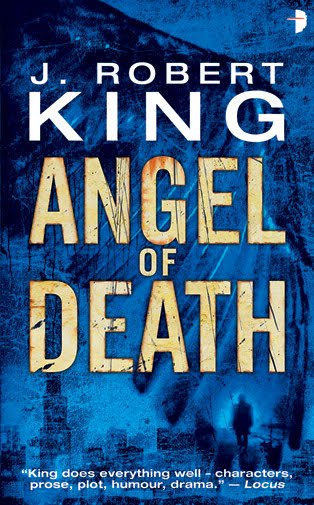
[Review] 'Angel of Death' by J. Robert King

Title: Angel of Death
Editor: J. Robert King
Pages: 286
Genre: Horror / Dark Fiction
Series/Standalone: Stand-alone with a sequel planned
Publisher: Angry Robot Books

The angel of death in Chicago oversees all people in the megalopolis, making sure their deaths fit their lives. Though most deaths naturally do, those that result from serial murder do not, so the angel spends much time trailing a serial killer in his patch.

On the trail of one such man, he encounters a cop and falls in love with her. When he is assigned to kill her, though, he has to make a choice between divinity and humanity.

An astounding new story from the critically-acclaimed J Robert King.


---

I am at a loss of words recently, when it comes to reviews, so writing this one has been an exceptionally challenging task. I suspected “Angel of Death” would be brilliant, because after all we are talking about Angry Robot Books, but “Angel of Death” rocketed pas preconceived expectations and made the reading experience hard to express with words.

As I said, I am at a loss of words. “Angel of Death” is the book you hold, no clutch, until your eyes smart, you can’t really focus on the words and you are not sure whether you are making any progress, because it’s way past your bedtime, but it’s too good to put the book down. It’s the fever that gets you slowly, the first pages spreading the infection. Then you begin to sweat as the suspense solidifies the breath in your lungs. You shiver as the good parts creep in, a bit too macabre, a bit too monstrous, a bit like watching something you morally shouldn’t be, but you are and, guess what, you love it, because it’s crass, forbidden and perverted. And because it is safe to. After all, this is fiction.

“Angel of Death” is that type of book. It’s not exactly horror it’s not exactly urban fantasy. It’s not concreted or defined, but it’s powerful. It has presence, much like “Slights” by Kaaron Warren. It possesses the same genre ambiguity, but delivers a chilling story with a narrator monster, which is far from us, the readers, but entrances us nevertheless.

Sure, I can talk book specifics about “Angel of Death”. The plot can be best described as an episode of Criminal Minds meets Hannibal Lector. The reader observes Samael, Angel of Death, assigned to the Chicago-Milwaukee area. He governs over accidental deaths as well as over the murders of the serial killers, working on his turf. Death here is pretty much a given. There are graphic details, but they read like grim poetry most of the time. Samael arranges the deaths, according to how the victims have lived their life. They are fitting and deserved. With a hidden meaning, only Samael understands.

Samael’s though process is fascinating to read, because it is alien, but also because it is as close to realistic as it can come. Looked from an angle, Samael is God’ serial killer and as the angel travels around Keith McFarland, the real world serial killer, the reader can see the parallel between the two characters.

What I further enjoyed in “Angel of Death” is the wide range between POV use. For Samael, King uses first person point of view. When the focus came on Keith, the POV switches to an ominous second person. Later when Detective Donna Leland becomes of importance, her chapters are written in third person point of view. This adds flavor and was not at all confusing for me, although it could very easily be.

Speaking of Donna Leland, she is the central to the story as much as Samael is. She turned the angel human, then the human into a monster. She is a small town cop, recently promoted to detective. She is alone, doesn’t feel pretty, but is overworked. She wants to do good, do the right thing and instantly becomes someone to relate to, because the instinct to help others is incredibly strong within her.

I give King high praise for the romantic plotline, which never entered the saccharine or the too-steamy-to-be-real territory. There are no candy kisses or spicy dialogue. No, you read about two people, who are in love. Two people, who shouldn’t be in love, because one is not human and for once, this theme of the forbidden inter-species love [because Donna & Samael’s relationship cannot be called romance] works.

Here I will stop. Of course, there is much, much more. Christian mythology. The fall from the divine to the demonic. Damnation. Salvation through murder. The quality of writing and storytelling, where you could only guess which is real and which is the delusion.

Grade: [A+] A must-read. Preferably late at night and with the right music font. Ingenious, daring and an uncomfortable journey through the psyche of a monster, which is also divine.
Related Posts with Thumbnails