Showing posts with label horror. Show all posts

Thursday, November 11, 2010

[Review] 'The Case of Charles Dexter Ward' by H.P. Lovecraft [Part 2]

Title: The Case of Charles Dexter Ward
Author: H.P. Lovecraft
Genres: Horror
Softcover: 128 pages
Publisher: originally by Weird Tales in 1941; my translation is from 2007 by Publishing Group Bulgaria
Standalone/Series: Standalone
Copy: Bought it myself

Blurb: Incantations of black magic unearthed unspeakable horrors in a quiet town near Providence, Rhode Island. Evil spirits are being resurrected from beyond the grave, a supernatural force so twisted that it kills without offering the mercy of death!

Available from: Amazon - US - UK | B&N | BookDepository

Cover Comment: I’m showing the cover of the most recent re-release of The Case of Dexter Ward [2008], which certainly is superior to its Bulgarian counterpart. Despite the easy to look at color combination, the cover doesn’t fail at its task to announce that the novel is horror and that it promises to be creepy. Also, I believe this cover art to be brilliant, because it is public friendly. If by any chance you read this in the park [in the bus/train] people won’t raise their eyebrows in disgust had this cover been with skulls or dead people. Everyone is happy.

Review: In the first part of my review [HERE] I discussed the first two chapters and touched upon the physical qualities of the text, the narration and the worldbuilding. Now, I’ll focus more on the plot, characterization and then speak about the themes.

Lovecraft considerately stalls the story with build-up and exposition. The first two chapters serve as blueprints for Ward and Curwen as characters. Chapter three continues in the same manner and maps out Ward’s transformations. But this process remains far from clear and reveals nothing to the reader. Supposedly, Ward experiments with far from normal materials and succeeds. At this point my patience stretched to the point I was not sure whether I could continue reading the novel as nothing really was said up straight. What are the purposes of the experiments? What triggered the changes in Ward? Why were bodies missing from the local graveyard? What was that smell in the library?

Thankfully, chapters four and five stopped with the irking foreshadowing and hinting and did their best to get to the heart of the mystery that Charles Dexter Ward had become. Lovecraft still manages to forbid the reader a full-frontal exposure by switching POVs between Charles, the family doctor, Mr. Willett and Charles’ father. In these chapters the Ward family becomes progressively worried about Charles’ health, so they begin an investigation of their own [but I have to say that the mother figure is passive and suffers from nerves throughout the book]. It’s discovered that Charles’ research lab, built in a bungalow as far away as possible from the family home, is inconspicuous, but the true horror is underneath the bungalow in a labyrinth of tunnels and chambers with alters inside.

SPOILER ALERT: Dr. Willett discovers that Charles performs rituals to raise spirits and gain knowledge. This process is coordinated with other necromancers all around the world, which have managed to cheat death once. At this point I stopped complaining about the book being a bit too mysterious for its own good and drooled as revelation after revelation happened on the page. While I’m in the spoiler section, I’ll mention how Lovecraft delivers a mighty twist I didn’t see coming. Turns out that the mysterious Dr. Allen, with whom Charles worked in the bungalow laboratory, was actually a resurrected Curwen. It was Curwen who killed Ward and then assumed his identity. By now this sounds a bit like a session of playing “Clue” with your friends and in retrospect, I should have seen this coming. For starters, Lovecraft underlines how much Charles resembles Curwen and Curwen’s portrait has been given a sort of sentient presence; much like in Dorian Gray. Ward’s contradictory behavior at the time of his death and the library as the place of murder [I mentioned the smell, now didn’t I?] function as small details that add flavor to the story, but de facto act as clues. < END SPOILER|

I won’t discuss the ending, for it is quite satisfying and has to be read. Willett’s confrontation with Ward in the asylum, which leads to the mystery depicted in the first chapter, is brilliant as a resolution. I will however stop to comment on Lovecraft’s rationalization of the fear of the unknown. Lovecraft suggests that we as a species demand for everything to have a logical explanation and that humankind has an image of how the world works. Now what can strike more fear in the hearts of men [once again I do refer to the male gender, because there were no female characters] than coming up against a process or an event, which we cannot fit in the model we have created for the world. It is through knowing this fear that Lovecraft manages to incorporate the supernatural into his tale.

In The Case of Dexter Ward the characters that represent intelligence and knowledge [despite shown as a formless mass] the psychiatrists fear expanding their horizons and are depicted as conservative. They represent how comfortable humans can be with their definition of reality and the world. Keeping in mind that there might be something else they can’t explain or even fathom is ridiculous for them. They fear that unknown, because they are powerless without answers. On the contrary, Dr. Willett faces that fear and overcomes it, because he keeps an open mind and works with what he has despite the impossibility of the situations he finds himself in.

Despite being a horror story about necromancers, mutated creatures and summoning rituals, The Case of Dexter Ward is at its heart a cautionary tale about knowledge. The necromancers’ goal is to achieve dominance through vast and unending knowledge. The narcotic dependency on knowledge, the constant thirst for it and the immoral methods for acquiring it are results of our need to explain things. I think Lovecraft’s message is that some things are better off left unknown as opposed to prodded lest they bite back.

What the Library Says: The library is pleased. The library senses a new re-print soon enough. The library is certain the novel will have an excellent shelf life.

Reviews I’ve seen: [so far none. If you are a book blogger and have a review of this book, tell me and I will link it for you]


Saturday, November 6, 2010

[Review] 'The Case of Charles Dexter Ward' by H.P. Lovecraft [Part 1]

Title: The Case of Dexter Ward
Author: H.P. Lovecraft
Genres: Horror
Softcover: 128 pages
Publisher: originally by Weird Tales in 1941; my translation is from 2007 by Publishing Group Bulgaria
Standalone/Series: Standalone
Copy: Bought it myself

Blurb: Incantations of black magic unearthed unspeakable horrors in a quiet town near Providence, Rhode Island. Evil spirits are being resurrected from beyond the grave, a supernatural force so twisted that it kills without offering the mercy of death!

Available from: Amazon - US - UK | B&N | BookDepository

Cover Comment: The shady, out-of-focus image that you’re seeing is the Bulgarian cover for this novel, which is a miserable cross between drawing and photo manipulation. My edition carries the novel The Case of Charles Dexter Ward as well as the novella Herbert West – Reanimator, which I think is why my book is called ‘The Re-Animator’. I never could find an image with better resolution and my copy is stashed somewhere I can’t find, so you can’t see how bad the cover actually is. Apart from trying to be current in design and failing at it, this is by far one of the better covers Bulgarian designers can produce. However, there is a lot on the cover that makes me cringe. Formatting the company name as the text the hunched man is so focused on writing is plain wrong as well as adding the title ‘The Call of Cthulhu’ in red, right lower corner. I wanted to comment on the cover to explain why SFF genre is not thriving here with original Bulgarian covers. It’s simply not eye-candy at best.

Review: The Case of Charles Dexter Ward is my first foray into Lovecraft and his demented fantasies, which I was more than convinced that I would love. My only regret so far is that my official christening is done through a translation and not in the original language, because I’m a firm believer that the original language holds more power over the reader. Even so, I found The Case of Charles Dexter Ward to be properly horrifying at the right places and interesting as a whole.

The novel is divided in five chapters, of which I will cover the first two and speak about the mechanics of the storytelling, the prose and worldbuilding. The story opens with ‘Conclusion and Prologue’, which introduces us to the setting [Providence in Rhode Island], presents the story [the sudden psychological and pathological degradation of the eccentric amateur-historian Charles Dexter Ward] and then the mystery [his disappearance from the asylum, where he has been treated]. From then on this brief section outlines the life of Charles: his childhood passion for history and genealogy, then his rapid changes from the harmless eccentricity to causing dread as well as his metamorphosis, where his interests shift from history to the modern world.

The interesting thing about Lovecraft is his heavy reliance on prose and omission of dialogue altogether. In his On Writing Stephen King speaks of Lovecraft’s inability to craft dialogue, which would explain the complete absence of it at large and also why when used, it’s done so in a sparing manner. I can’t judge that weakness, but it shows a great skill to labor one story without such a key component. What contributed to the success of this storytelling model is the documentary feel to it. Lovecraft has meticulously noted down a detailed timeline with a great many inserted opinions from different people and sources. The combined effect is one of omniscience based on the accumulated accounts and that this story can be nothing but true.

In the second chapter, ‘Past and Nightmare’ Lovecraft dedicates sixty pages to piece together the past of Joseph Curwen, Ward’s mysteriously discovered relative. Lovecraft charts his arrival to Providence, his accession as a successful trader, his shrouded in mystery hobbies and the communal outrage towards his activities, which results into an expedition of 100 men and his supposed murder.

Even though Curwen is deceased, he’s relevant to the story as it’s his legacy that acts as a catalyst for Ward’s transformation. It’s why Lovecraft goes at great length to flesh him out. Joseph’s story is sewn together from excerpts from letters, journals, registers and old newspapers. I could sense how passionate Lovecraft was while adding these details and this investigative approach to his research.

Where Lovecraft shines with his worldbuilding is with Providence. His narrative is littered with small sidetracks; perhaps two lines or even a phrase to add a small, inconsequential bit or trivia. Whereas modern horror often thrive in isolation; encapsulated in a house, a cottage, a flat or in a day, a week, a month and often exclude the city and society as characters. Here it’s the opposite. The reader is not only whisked away into the past to read of Joseph’s story, but to read of Providence as well.

Last but not least, I’d like to speak of Lovecraft’s horror. It’s widely known that the quote: ‘The oldest and strongest emotion of mankind is fear, and the oldest and strongest kind of fear is fear of the unknown.’ belongs to Lovecraft and he practiced what he preached. In chapter two, I was chilled at several places without really getting direct answers. Joseph’s farm, the experiments he conducts there and the townsfolk expedition remain shrouded in secrecy with only hints and indirect accounts as to what unholy things transpired.

I found this both intriguing, annoying and dread inducing. The modern reader [horror lover] is accustomed to full frontal, visual attacks, high-definition and uncensored in rendition of gore, blood and deformity. Lovecraft shifts the focus from sight to hearing and smell [rarely relying on sights and when horrors are described the account is secondary] and remains vague at large in his descriptions. The mixture of awareness that something horrid is transpiring and the fact that these events are unrestricted by any dimensions is truly potent.

The reader can fill out the blanks with his/hers own personal phobias, thus amplifying the fear. Because where one fears snakes, another might love them, which can be said about pretty much everything. Scaring a lot of people with a plethora of different terrors is a challenge, especially to the modern jaded horror fan. Lovecraft’s technique is successful, because the fear of the unknown is still a primary fear.

Next Part: In the next part, I will pay more attention to the plot of the novel and later discuss the themes in the story. I warn you that tomorrow’s plot discussion will have only one spoiler but it’s the crux of the mystery, so you better watch out for my sign.

NOTE: Hope you enjoyed this a bit improved method for reviewing novels. I welcome all sort of feedback.

Friday, October 15, 2010

[Video] Supernatural Anime Trailer

I'm not sure whether I would have the strength to watch season five of Supernatural. For me that show died after I learned they were not going to conclude with its fifth season, but would stretch it and well, Paris Hilton made a cameo appearance. These factors and the watered down back to basics approach is far from pleasing. My angry, fat, cheetos-eating fan boy that snorts is so not pleased with this.

BUT the Japanese may rescue Supernatural with the new anime based closely to the TV series, which will air in 2011. Supernatural horror is their genre and they will know how to convey that needed atmosphere as well as scare the shit of us. Considering the intensity with which family members interact in Japanese pop culture, Sam and Dean will be in for an interesting treatment. The anime trailer so far seems promising:


Sunday, September 26, 2010

[Beyond the Wordcount] The Genesis of 'Angel of Death'


Do you wonder how a book is made? If you are an avid reader and the sight of a book makes you glow, then you probably have wondered about a novel’s journey from idea to hard/softcover delight on your local bookstore’s shelf. Did the author discover the story whole and intact? Did the story need countless revisions? How much is researched and how much is the product of the author’s imagination? What did the author have to go through to publish that novel you just love? Beyond the Wordcount is the feature that will give a behind-the-scene look to the story behind the story, the things that you will never guess as they stay off the pages.

This week’s guest is J. Robert King. He is the author of one my favorite novels Angel of Death [Review],which impressed me with its realistic depiction of a monster. If you think American Psycho was frightening, because Patrick Bateman could very well exist, than the Angel in King's novel will stop your pulse with his sound logic.

Bio: J. Robert King is the award-winning author of over twenty novels, most recently The Shadow of Reichenbach Falls and the Mad Merlin trilogy. Fifteen years ago, Rob founded the Alliterates, a cabal of writers in the Midwest and West Coast of the U.S. Rob also often takes to the stage, starring in local productions such as The Complete Works of William Shakespeare (Abridged) and Arsenic and Old Lace. He lives in Wisconsin with his lovely wife, three brilliant sons, and three less-than brilliant cats.

Blurb:
The angel of death in Chicago oversees all people in the megalopolis, making sure their deaths fit their lives. Though most deaths naturally do, those that result from serial murder do not, so the angel spends much time trailing a serial killer in his patch.

On the trail of one such man, he encounters a cop and falls in love with her. When he is assigned to kill her, though, he has to make a choice between divinity and humanity.


The Task: I asked Robert to write a post detailing he created his character and pieced the psyche of a sociopath-monster. What I received exceeded my expectations. King not only answered my question about Azrael, but also presented a genesis for his novel.

---

People wonder where Angel of Death came from. It is, after all, a dark book.

Well, the quick explanation is that the book I'd written before it had been rejected by multiple publishers, and I was pissed off and wanted to write a pissed-off book. That's the quick explanation, and it's the truth, but it's not the whole truth.

Let's look at the elements of Angel of Death. First, of course, there's an angel, a servant of God who is charged to kill us. If this angel were human, he would be a serial killer. It is his very divinity that makes his actions right and good. Were this angel to lose his divinity and become human, quiet suddenly the work he has been mandated to do becomes the most monstrous act imaginable.

So, if God tells you to do it, you are justified in doing it, right?

Think about suicide bombers, sixteen-year-old kids from slums blowing themselves up. We think this is horrific, but the bombers do not, nor the men who strap explosives to them, nor the mothers who mourn them as holy martyrs. All of these people know that God wants sixteen-year-old boys to have their bodies ripped apart and have their bones fly as shrapnel to rip apart others.

Sin is disobedience to God, so if God wants you to kill yourself, then living is sin. If God wants you to kill the other passengers on the commuter train, then sparing them is sin. If God wants an old man to take his only son up to a mountain and ram a knife into the boy's heart, the old man is not a murderer but a saint.

That is, in part, what Angel of Death is. It's an exploration of the terrifying and grotesque nature of faith that justifies such atrocities.

Of course, to pull off a novel like this, I had to do a lot of reading about actual serial killers-- peering into their psyches, studying their crimes, watching them do what they did to their victims. I was appalled. I could not have imagined such depravity. What human beings are capable of doing to each other beggars the mind. I had launched this book to rail against God but found human crimes to be equally horrendous. Just when I was about to nail God to the wall, I discovered I had to nail myself there, too, and every other human being.

Like I said, this book came from a pretty dark place.

So, I started to write. At first, it was just me and the angel, wrestling. But I knew I wouldn't win a match like that. I brought in Donna Leland to distract the angel so that maybe I could escape. She was the good human there trapped between me and my monster. And the novel just unfolded that way. I didn't so much write it but chronicle it, observing with a kind of sick terror as Donna struggled to understand and then to love and then to escape Azrael.

I hid behind Donna, hoping she could save us both.

All right, so you know two thirds of the story, the railing against God and the railing against humanity. But the third part of Angel of Death—the part that makes it especially unsettling to my family and friends—is that I put all of them in it. I set the scenes in the town where I live and the town where I grew up and even the flood-prone Methodist campground where I spent many summers as a youth. The angel kills a young couple driving through Chicago on their way to Disney World on their honeymoon—a precise description of my wife and I when first we were married. The angel kills Mr. Strange, a garbage man in my hometown who was reprimanded for stalking my little sister. The angel kills all sorts of people I know, but mostly kills me in different phases of life.

Over and over, that angel is killing me. It was the one way I could escape him. Let him kill me again.

Yes, Angel of Death came from a really dark place.

It's a furious book, a murderous book, and I'm glad it is on paper now instead of in my mind. Of course, if the Angel of Death has his way, this book will somehow still be the death of me.

We'll see.

Sunday, August 22, 2010

Taking Stock

Having catalogued most of my book collection on Goodreads I have found that there are now 304 UNREAD books in the theoretical ‘To be read’ pile. That is more than I thought, and the number is still growing as I feed my addiction to the printed page. Not all are Science Fiction / Fantasy / Horror genre novels, though the majority fall within these categories. I read non-fiction too, mainly eco-politics, history, rock biographies and travel books, but Fantasy is by far the most populated category with 256 books out of a total of 721 that I have added to Goodreads so far. So, with a move to the north of England coming up later this year, I am taking stock of my collection and trying to prioritise some kind of reading order for the books I already own.

Science Fiction
I want to read more classic Science Fiction and have collected a number of the excellent Gollancz SF Masterworks series. Top of the list to read is Flowers for Algernon by Daniel Keyes…
“Charlie Gordon, IQ 68, is a floor sweeper, and the gentle butt of everyone’s jokes, until an experiment in the enhancement of human intelligence turns him into a genius. But then Algernon, the mouse whose triumphal experimental transformation preceded his, fades and dies, and Charlie has to face the possibility that his salvation was only temporary.”
From flicking through the book, it appears that the story is told by way of progress reports written by Charlie himself. This appeals to me as a way of describing the effects the experiment has on Charlie, how he copes with the changes he experiences and the emotional impact of these.

I have long been a fan of classic British SF, having grown up watching TV adaptations of The Day of the Triffids, and Quatermass alongside Dr Who and Blake’s Seven. I have recently been catching up with authors such as John Christopher, Arthur C. Clarke and H.G.Wells and next in my list is The Chrysalids by John Wyndham. The Day of the Triffids and The Midwich Cuckoos are probably more well known, but The Chrysalids comes highly recommended as possibly the least dated of his novels…
“The Chrysalids is a post-nuclear apocalypse story of genetic mutation in a devastated world and explores the lengths the intolerant will go to keep themselves pure.”
Anyone who knows my reading preferences will be aware of my love of post-apocalyptic fiction and so I am keen to read The Chrysalids as it was written in 1955, when the threat of a nuclear holocaust was very real.

Next up is The Complete Robot, the definitive anthology of Isaac Asimov’s stunning visions of a robotic future. This is classic SF at it’s finest, if the multitude of reviews and recommendations online are anything to go by. I enjoyed the film I, Robot, but have been warned that The Complete Robot is much, much more than the film…
“In these stories, Isaac Asimov creates the Three Laws of Robotics and ushers in the Robot Age: when Earth is ruled by master-machines and when robots are more human than mankind.”
Last in the list of classics are two books by Philip K. Dick: A Scanner Darkly and Do Androids Dream of Electric Sheep? An American author, renowned for exploring political, sociological and metaphysical themes in his novels and short stories, he is an author I have never read. I have thoroughly enjoyed the films based on his writing; Bladerunner, Total Recall and Minority Report for example, yet have never read the source material. Both books are part of the Gollancz SF Masterworks series.
A Scanner Darkly: “Substance D – otherwise known as Death – is the most dangerous drug ever to find its way onto the black market. It destroys the links between the brain’s two hemispheres, leading first to disorientation and then to complete and irreversible brain damage. Bob Arctor, undercover narcotics agent, is trying to find a lead to the source of supply, but to pass as an addict he must become a user…”
Do Androids Dream of Electric Sheep?: “War has left the Earth devastated. Through its ruins, bounty hunter Rick Deckard stalks the runaway androids who are his prey. When he isn’t ‘retiring’ them, he dreams of owning the ultimate status symbol – a live animal. Then Rick gets his next assignment: to track down six Nexus–6 targets, for a huge reward. But life is never that straightforward and Rick’s quickly turns into a kaleidoscopic nightmare of subterfuge and deceit.”


Fantasy
Fantasy is by far my favourite genre and while I have read a lot of Fantasy over the years, I still have some catching up to do! I sometimes get sidetracked by Urban Fantasy and Paranormal Romance, as they tend to be light, enjoyable reads requiring little concentration or thought on my part, but epic fantasy, particularly involving the Sidhe, Fae/Fairy, or Elves are a real favourite of mine. This could be because I grew up in Ireland on tales of banshees, mythical heroes and magical beings. I also read the Chronicles of Narnia quite young, followed by The Hobbit and then later, the Lord of the Rings trilogy, so the preference was set early on in my reading career.

It is at this point that I have to admit to never reading some of the most well known and popular fantasy authors such as Robert Jordan, Steven Erikson, or Terry Goodkind for example, and possibly may never do so. I have bought books by Guy Gavriel Kay, Terry Brooks, Lois McMaster Bujold, Tad Williams and Mary Gentle but they are still amongst the many waiting to be read. So, in order to start catching up on the range of classic fantasy books I have not yet read, here are the five I have selected as ones I really must read as soon as possible…

First up, and one which may shock the sensibilities of many a Fantasy fan is The Name of the Wind by Patrick Rothfuss. I bought it when it was first released in paperback, took it to New Zealand last Christmas, intending to read it on the return journey but left it behind as my bag was over weight. My sister and brother-in-law thoroughly enjoyed it! I have since repurchased it and am determined to read it before the sequel is released next year.
“I have stolen princesses back from sleeping barrow kings. I burned down the town of Trebon. I have spent the night with Felurian and left with both my sanity and my life. I was expelled from the University at a younger age than most people are allowed in. I tread paths by moonlight that others fear to speak of during the day. I have talked to Gods, loved women, and written songs that made the minstrels weep.
My name is Kvothe. You may have heard of me.”
With a blurb like that, I’m not sure why I haven’t devoured this book long before now. And so it takes the top spot in my list of Fantasy books I really must read!

Next up is George R.R. Martin’s A Game of Thrones, book one of A Song of Ice and Fire series. It is currently being made into a TV series, filmed in Belfast, and I fully intend to have this book read before it is broadcast. It has been described as ‘one of the greats’ and while I tend to shy away from multi-volumes series, I like the sound of this epic fantasy.
“As Warden of the north, Lord Eddard Stark counts it a curse when King Robert bestows on him the office of the Hand. His honour weighs him down at court where a true man does what he will, not what he must… and a dead enemy is a thing of beauty. The old gods have no power in the south, Stark’s family is split and there is treachery at court. Worse, a vengeance-mad boy has grown to maturity in exile in the Free Cities beyond the sea. Heir of the mad Dragon King deposed by Robert, he claims the Iron Throne…”
Some familiar Fantasy themes here, plus dragons, I think I will enjoy reading this hefty tome.

I have read some of Elizabeth Moon’s Science Fiction but have overlooked her fantasy books. With Oath of Fealty, book one of Paladin’s Legacy I aim to change this situation. She comes highly recommended, and as I have a tendency to prefer female authors, I am interested to see how she writes Fantasy.
“An unexpected death has made Kieri Phelan king of Lyona. Here humans and elves live in uneasy peace, united only by their failure to see the dangers at their borders. Harmony has never been more important – or elusive. But will Kieri’s soldier background allow him to navigate these difficult politics? And can he awaken the powers his mixed blood promises?
An older evil also threatens Lyona, and all surrounding kingships. The Verrakai family has been practising forbidden blood magic for generations, and its scions are becoming bold. When they infiltrate a foreign court and assassinate key nobles, it’s clear they must be controlled, or eradicated. Phelan will send Dorrin, the only Verrakai he can truly trust, on this mission. She must overcome her abhorrence of the power that is her birthright and awaken her own hidden magic. This will lead to long-hidden secrets and a mystery that neither Phelan nor Dorrin could have anticipated.”
Politics, court intrigue, elves, magic; these are all very appealing ingredients for me so I am eager to find out why Elizabeth Moon’s fantasy writing is highly praised.

When I mentioned on Twitter that I had not read The Lies of Locke Lamora there were several shocked responses. Scott Lynch’s debut novel, the first in The Gentleman Bastards Sequence (what a great title for a series!) appears on many lists of favourite novels so I am curious to find out for myself what all the fuss is about.
“The Thorn of Camorr is said to be an unbeatable swordsman, a master thief, a friend to the poor, a ghost that walks through walls.
Slightly built and barely competent with a sword, Locke Lamora is, much to his annoyance, the fabled Thorn. And while Locke does indeed steal from the rich (who else would be worth stealing from?), the poor never see a penny. All of Locke’s gains re strictly for himself and his tight-knit band of thieves: The Gentlemen Bastards.
The capricious, colourful underworld of the ancient city of Camorr is the only home they’ve ever known. But now a clandestine war is threatening to tear it apart. Caught up in a murderous game, Locke and his friends are suddenly struggling just to stay alive…”
Certainly The Lies of Locke Lamora appears to be an irreverent swashbuckling adventure story and I am fond of a novel where the main characters are not good, honourable and noble heroes.

Finally, another great author I have not yet read, despite owning at least four of his standalone novels, is Guy Gavriel Kay. I intend to rectify this by starting with the first in his Fionovar Tapestry series, The Summer Tree.
“The first volume in Guy Gavriel Kay's stunning fantasy masterwork. Five men and women find themselves flung into the magical land of Fionavar, First of all Worlds. They have been called there by the mage Loren Silvercloak, and quickly find themselves drawn into the complex tapestry of events. For Kim, Paul, Kevin, Jennifer and Dave all have their own part to play in the coming battle against the forces of evil led by the fallen god Rakoth Maugrim and his dark hordes. Guy Gavriel Kay's classic epic fantasy plays out on a truly grand scale, and has already been delighting fans of imaginative fiction for twenty years.”
I generally enjoy reading novels where people from our own world are suddenly transported to a magical other world, for example, Narnia, or The Talisman by Stephen King and Peter Straub, so this epic fantasy trilogy would seem to be as good a place to start as any.

The ten books listed here are my planned reading over the next few months and I intend to review them as I finish each one. I will continue to read new novels… I have I Am Number Four by Pittacus Lore, Lonely Werewolf Girl by Martin Millar and Naamah’s Curse by Jacqueline Carey already lined up. So the intention is to read one ‘classic’ followed by one ‘new’. Whether that plan will actually happen is anyone’s guess as I can be quite fickle when it comes to choosing my next book from the ever-increasing pile. Only time will tell!

Sunday, June 6, 2010

REVIEW: Heart-Shaped Box by Joe Hill

Title: Heart-Shaped Box
Author: Joe Hill
Hardcover: 365 pages
Publisher: Gollancz; Airport Edition, (15 Mar 2007)
ISBN-10: 0575079126
ISBN-13: 978-0575079120
Genre: Horror
Reviewer: Cara
Copy: Bought myself

Synopsis:
‘Buy my stepfather’s ghost, read the email.’ So Jude did.

When Jude Coyne heard someone was selling a ghost on the internet, there was no question what he was going to do. It was perfect for his collection of the macabre and the grotesque: the cannibal’s cookbook, the witch’s confession, the authentic snuff movie. As an aging death-metal-rock-god, buying a ghost almost qualifies as a business expense.

Besides, Jude thinks he knows all about ghosts. Jude has been haunted for years… by the spirits of bandmates dead and gone, the spectre of the abusive father he fled as a child, and the memory of the girl he abandoned, who killed herself. But this ghost is different. Delivered to his doorstep in a black heart-shaped box, the latest edition to Jude’s collection makes the house feel cold. It makes the dogs bark. And it means to chase Jude from his home and make him run for his life…


Faded rock star Jude Coyne (I kept thinking Marilyn Manson throughout) is basically a grumpy middle-aged man rattling around in his large ranch house with his assistant Danny, his dogs and his latest girlfriend. He is jaded, bored and without focus. His former bandmates have either died or moved on, and he has a succession of relationships with younger goth-girl types, whom he calls after the state in which he picked them up. But when his assistant receives an email about a ghost for sale on the internet, Jude has to have it to add to his suitably clichĆ©d rock star collection of ‘weird’ things. It arrives – in a heart-shaped box - and this is where the fun begins… this ghost is for real!

The first 120 or so pages are an exciting read. The plot is set, the characters introduced and the creepiness builds. I enjoyed Joe Hill’s sometimes humorous style and was getting into my stride when things fell apart a bit. Overlong character histories slowed the pace down considerably and detracted from the plot. I found myself getting bored but just as I was thinking about giving up, having lost interest in Jude, a plot twist sucked me back in and I quite happily read Heart-Shaped Box through to its conclusion.

Having read some of Joe Hill’s short stories I was looking forward to his debut novel. What soon became clear is that Heart-Shaped Box most definitely is a promising start to a writing career. It is not perfect, indeed the middle third is at times like wading through treacle, but the plot is strong and the characterisation is good. Jude is no more likeable at the end of the book than he is at the beginning, but at least he knows why he is like he is. An anti-hero of sorts, he runs away from the present only to find his past catching up with him. The ghost, on the other hand, is very, very creepy. He manipulates the minds of others and you certainly would not want Craddock McDermott haunting your dreams. Georgia’s progression to Marybeth is well done and I found her to be the most likeable character in the book.

Overall, Heart-Shaped Box is a book of thirds; a strong introduction, dragging middle and satisfying conclusion. Inevitably there are comparisons to the master of popular horror fiction - and the author’s father - Stephen King, but I think this is unfair despite both writing in the same genre. Joe Hill has a modern voice, one with room to develop. His writing style is a little inconsistent here but that, I think, is something that will come in time. Certainly I am looking forward to reading Horns, his second novel.

Rating 6/10

Monday, April 26, 2010

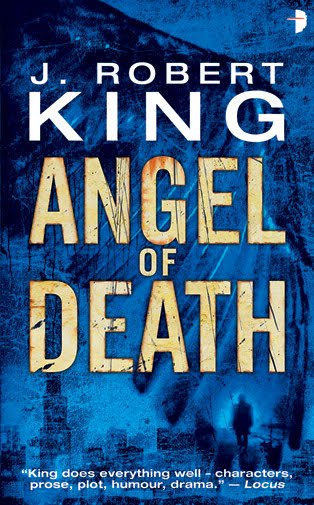
[Review] 'Angel of Death' by J. Robert King

Title: Angel of Death
Editor: J. Robert King
Pages: 286
Genre: Horror / Dark Fiction
Series/Standalone: Stand-alone with a sequel planned
Publisher: Angry Robot Books

The angel of death in Chicago oversees all people in the megalopolis, making sure their deaths fit their lives. Though most deaths naturally do, those that result from serial murder do not, so the angel spends much time trailing a serial killer in his patch.

On the trail of one such man, he encounters a cop and falls in love with her. When he is assigned to kill her, though, he has to make a choice between divinity and humanity.

An astounding new story from the critically-acclaimed J Robert King.


---

I am at a loss of words recently, when it comes to reviews, so writing this one has been an exceptionally challenging task. I suspected “Angel of Death” would be brilliant, because after all we are talking about Angry Robot Books, but “Angel of Death” rocketed pas preconceived expectations and made the reading experience hard to express with words.

As I said, I am at a loss of words. “Angel of Death” is the book you hold, no clutch, until your eyes smart, you can’t really focus on the words and you are not sure whether you are making any progress, because it’s way past your bedtime, but it’s too good to put the book down. It’s the fever that gets you slowly, the first pages spreading the infection. Then you begin to sweat as the suspense solidifies the breath in your lungs. You shiver as the good parts creep in, a bit too macabre, a bit too monstrous, a bit like watching something you morally shouldn’t be, but you are and, guess what, you love it, because it’s crass, forbidden and perverted. And because it is safe to. After all, this is fiction.

“Angel of Death” is that type of book. It’s not exactly horror it’s not exactly urban fantasy. It’s not concreted or defined, but it’s powerful. It has presence, much like “Slights” by Kaaron Warren. It possesses the same genre ambiguity, but delivers a chilling story with a narrator monster, which is far from us, the readers, but entrances us nevertheless.

Sure, I can talk book specifics about “Angel of Death”. The plot can be best described as an episode of Criminal Minds meets Hannibal Lector. The reader observes Samael, Angel of Death, assigned to the Chicago-Milwaukee area. He governs over accidental deaths as well as over the murders of the serial killers, working on his turf. Death here is pretty much a given. There are graphic details, but they read like grim poetry most of the time. Samael arranges the deaths, according to how the victims have lived their life. They are fitting and deserved. With a hidden meaning, only Samael understands.

Samael’s though process is fascinating to read, because it is alien, but also because it is as close to realistic as it can come. Looked from an angle, Samael is God’ serial killer and as the angel travels around Keith McFarland, the real world serial killer, the reader can see the parallel between the two characters.

What I further enjoyed in “Angel of Death” is the wide range between POV use. For Samael, King uses first person point of view. When the focus came on Keith, the POV switches to an ominous second person. Later when Detective Donna Leland becomes of importance, her chapters are written in third person point of view. This adds flavor and was not at all confusing for me, although it could very easily be.

Speaking of Donna Leland, she is the central to the story as much as Samael is. She turned the angel human, then the human into a monster. She is a small town cop, recently promoted to detective. She is alone, doesn’t feel pretty, but is overworked. She wants to do good, do the right thing and instantly becomes someone to relate to, because the instinct to help others is incredibly strong within her.

I give King high praise for the romantic plotline, which never entered the saccharine or the too-steamy-to-be-real territory. There are no candy kisses or spicy dialogue. No, you read about two people, who are in love. Two people, who shouldn’t be in love, because one is not human and for once, this theme of the forbidden inter-species love [because Donna & Samael’s relationship cannot be called romance] works.

Here I will stop. Of course, there is much, much more. Christian mythology. The fall from the divine to the demonic. Damnation. Salvation through murder. The quality of writing and storytelling, where you could only guess which is real and which is the delusion.

Grade: [A+] A must-read. Preferably late at night and with the right music font. Ingenious, daring and an uncomfortable journey through the psyche of a monster, which is also divine.

Tuesday, April 6, 2010

[NEWS] Horror Icons market Burger King

People like burgers and it's proven that people enjoy the occasional bloody slasher movie [from the late 80s - early 90s, if possible]. It took long enough, but the Dubai advertising agency 'Tonic' has found a way to coalesce the two things Americans love in this advertising campaign for 'Burger King'. I am not sure why exactly 'Burger King' [the prime suspect for obesity in the US] would go for horror, when marketing their food, but I gotta admit; Chucky is quite cute. The news comes from the ever hilarious Cinema Scrotum.

Friday, March 19, 2010

[Review Anthology] Dead Souls Part 3

Title: Dead Souls
Editor: Mark S. Deniz
Pages: 286
Genre: Horror / Dark Fiction
Anthology: 25 Stories
Publisher: Morrigan Books

Dead Souls contains twenty five stories that will only ensure the darkness without enfolds you in its cold embrace…beware…be ready…be damned! Before God created light, there was darkness. Even after He illuminated the world, there were shadows — shadows that allowed the darkness to fester and infect the unwary. The tales found within Dead Souls explore the recesses of the spirit; those people and creatures that could not escape the shadows. From the inherent cruelness of humanity to malevolent forces, Dead Souls explores the depths of humanity as a lesson to the ignorant, the naive and the unsuspecting. God created light, but it is a temporary grace that will ultimately fail us, for the darkness is stronger and our souls…are truly dead.


CONTENTS

Bernie Mojzes The Collector
T. A. Moore Licwiglunga
Carole Johnstone The Blind Man
Tom English Dry Places
Sharon Irwin Begin with Water
Robert Holt In the Name
William Ward When they Come to Murder Me
Chris Johnstone The Unbedreamed
Elizabeth Barrette Goldenthread
Catherine J. Gardner When the Cloak Falls
Anna M. Lowther The Price of Peace
James R. Stratton Your Duty to your Lord
Kenneth C. Goldman Mercy Hathaway is a Witch
Lisa Kessler Immortal Beloved
Lisa Kessler Subito Piano
Michael Stone The Migrant
Robert Hood Sandcrawlers
Reece Notley Tatsu
L. J. Hayward Wayang Kulit
Rebecca Lloyd Contaminator
Ramsey Campbell The Dead Must Die
Stephanie Campisi The Ringing Sound of Death on the Water Tank
Paul Finch June
Gary McMahon A Shade of Yellow
Kaaron Warren The Blue Stream

---
As ‘Dead Souls’ progresses, the reader steals through the streams of time and leaves the years of fairy tales and fears of the external behind to immerse himself in the horror that originates from within. As humanity builds upon civilization and catalogues explanations of everything that transpires, the horror does not come from the environment from the people, surrounding us. The Beast Within submerges the readers in this fear and in five distinct exposĆ©s stays true to the theme of the anthology, while casting limelight on the internal bestiary humans hide inside their ribcages, both metaphorically and literally.

In Mercy Hathaway is a Witch by Kenneth C. Goldman the reader is whisked away to Boston during the Salem Witch Trials, when women were feared, suspected and accused as vessels of Satan himself. The protagonist is a young Jonathan Browne, who is soon to inherit his father’s practice and marry his sweetheart Miss Amelia. However, his life is altered severely, when he escorts Amelia’s seamstress Mercy Hathaway. Though it starts off straightforward and rather predictable, Goldman has taken the witch theme and ran wild with a twist ending, which is most satisfying and grim.

The highlight in The Beast Within stems from Lisa Kessler’s involvement in the anthology. Her Immortal Beloved and Subito Piano are sibling short stories, which recall Anne Rice in setting, atmosphere and the sophistication of vampires rather their sexual objectification in recent years and novels. On the surface there is not much to these stories. The elements are all the same everywhere. Vampires with tortured pasts, humans who want immortality and angst bred with melancholy. However, only when read together as they are listed in Dead Souls can the reader appreciate the artistry and the play between works. Subito Piano acts as an echo as well as a sequel to what happens in Immortal Beloved, while in the same time the pianist, who unifies both pieces remains offstage and yet the reader can feel her presence.

The Migrant by Michael Stone offers supernatural insight as to how Adolf Hitler transformed into the monster Europe suffered under for so long. Considering Hitler’s personality I bought the concept Stone presented. The creativity and attention to detail invested in The Migrant as to mold the supernatural into historical reality as well as the use of Christian Mythology and black irony, impressed me. On the other hand, I never fancied World War II as a setting or as a theme, so I didn’t experience this story the same way as a World War II enthusiast and SFF enthusiast would.

Sandcrawlers by Robert Hood is bereft of speculative fiction. At least I would never classify it as speculative fiction and that almost made me drop it completely, but since it took place in the UK I pushed on to see what actually transpires in between the pages. Fine, so I established Hood’s story is not spec-fic, but still fits perfectly in the theme of the anthology and this segment. Because there’s no evident supernatural foul-play the horror here is starker, since all the atrocity and cruelty stems from an average, middle-aged man. It does not take too much to conclude that middle-aged males are quite common as a demographic and it is that realization that gives the extra punch.

Tuesday, March 9, 2010

"Slights" by Kaaron Warren

It's Angry Robot Book Marathon on Temple Library Reviews, so I am bringing out past reviews from the books that I have read and loved along for the ride. It just seems like a shame to let all these great titles go without a second shot out. So here is what I thought of 'Slights' way back in August 2009.

---

Title: "Slights"
Author: Kaaron Warren
Pages: 528
Genre: Horror
Standalone/Series: Standalone
Publisher: Angry Robot

What you can expect:
Perhaps one of the most disturbing psychological horror stories imbued with withering decadence and written as a memoir. This story haunted me and froze my blood in a manner I have yet to encounter.

Pros: Original. From conception to execution Kaaron Warren redefined fear for me and stole my breath. Characterization explores the deepest, darkest aspects of the human mind and surpasses what I ordinarily expect.

Cons: Its built-up was painfully slow. At times I wondered whether I was reading just a stranger than average mainstream novel or a horror one. I admit the waiting was worth it, but boy was it nerve wrecking.

Summary: Stephanie “Stevie” Searle has never had it easy. Her father, a cop, died back when she was nine years old under mysterious consequences, leaving her with a mother she can’t connect to and a brother, who constantly overshadowed Stevie throughout their whole lives. At the age of eighteen, after a car accident, where she was the driver, Stevie loses her mother and has a near death experience that changes her life. In it Stevie awakes in a dark room with all the people she ever slighted gathered around her to exact their revenge. This creates an unhealthy relationship and fascination with death, which slowly transform her into a monster of her own device.

Characters: I can’t recall ever reading a memoir at least outside classic titles and even there my memory serves against me, so to witness a very clear distinction between a sole, active character and the rest presented exclusively through that person’s mind frame is quite a jolt and offers a break from typical characterization. It’s a tricky business to get a person excited over a memoir-type story that isn’t an action story, but rather a slice-of-life in design, and resting the success on one character is risky. To pull it off the author must understand enough of human psychology to pen a believable protagonist s well as pull the readers’ strings right.

This is where Warren eclipses most fiction I have ever read, since she covers all the criteria listed above and doing so with one of the most unsympathetic human beings ever conceived in a novel as far as my reading experience is concerned. Stevie is a train-wreck caught in a loop and possesses the most unflattering set of human traits, which instantly cause revulsion in the reader. I couldn’t connect with her or identify myself with her position in life, but I wanted her to find peace for she was hurting. This was the cord that attached me to the story and kept me reading. Was Stevie ever going to find closure and end her frantic search? By the end of the novel, I wished I hadn’t asked it.

Story: I managed to identify two plots intertwined through the whole book. The first one dealt with Stevie’s obsession with death and the afterlife. This is where Warren’s originality and master craftsmanship in horror shine through. So far mythology and fiction have agreed that hell is one big place for all sinners. Kaaron toys with the idea of individual hell for each human populated with all the people one has slighted, while the slighted appear in countless other hells’. It’s, I think, revolutionary in the way fiction has viewed the afterlife and Stevie’s exploration and documentation of it comes after many trips to the dark room.

I loved that Stevie never stuck with one technique to commit suicide and experimented a lot. Funny thing is that she never expected to get rescued and counted on dying, so surviving so many suicide attempts makes her quite lucky, though she doesn’t view it that way. In the end though it’s all valuable information. But she doesn’t always restrict her research to herself and branches out with her dying patients she meets in her line of work as a nurse as well as her own test subject lured in from the street. It’s the transition from strange interest and harmless observation to murder in the quest for knowledge that’s sickening and yet beautiful.

The emotionally cold and intelligent madness that has taken over Stevie’s life is what makes her the most frightening villain or monster. The second plot line in “Slights” reveals where this madness stems from and that it had nested long ago in the family, when Stevie decides to dig in the backyard in order to plant jasmine. It turns out her father was a serial killer of sorts, which means the killer gene was hereditary. Through flashbacks, episodes with Doug, Stevie’s dad’s former partner, as well as Stevie’s aunt’s cryptic messages the reader learns the whole story behind the Searle’s family secrets.

The Verdict: [A++] A most grotesque mosaic of human debauchery and demoralization, whose beauty lies within the intricacy of its design. It builds painfully slow, but when “Slights” reaches its most potent state you will fear contact with strangers. I have more to say, much, much, but I want you to find all the surprises. Must-read.

Friday, March 5, 2010

[Review Anthology] Dead Souls: Part 1

Title: Dead Souls
Editor: Mark S. Deniz
Pages: 286
Genre: Horror / Dark Fiction
Anthology: 25 Stories
Publisher: Morrigan Books

Dead Souls contains twenty five stories that will only ensure the darkness without enfolds you in its cold embrace…beware…be ready…be damned! Before God created light, there was darkness. Even after He illuminated the world, there were shadows — shadows that allowed the darkness to fester and infect the unwary. The tales found within Dead Souls explore the recesses of the spirit; those people and creatures that could not escape the shadows. From the inherent cruelness of humanity to malevolent forces, Dead Souls explores the depths of humanity as a lesson to the ignorant, the naive and the unsuspecting. God created light, but it is a temporary grace that will ultimately fail us, for the darkness is stronger and our souls…are truly dead.


CONTENTS

Bernie Mojzes The Collector
T. A. Moore Licwiglunga
Carole Johnstone The Blind Man
Tom English Dry Places
Sharon Irwin Begin with Water
Robert Holt In the Name
William Ward When they Come to Murder Me
Chris Johnstone The Unbedreamed
Elizabeth Barrette Goldenthread
Catherine J. Gardner When the Cloak Falls
Anna M. Lowther The Price of Peace
James R. Stratton Your Duty to your Lord
Kenneth C. Goldman Mercy Hathaway is a Witch
Lisa Kessler Immortal Beloved
Lisa Kessler Subito Piano
Michael Stone The Migrant
Robert Hood Sandcrawlers
Reece Notley Tatsu
L. J. Hayward Wayang Kulit
Rebecca Lloyd Contaminator
Ramsey Campbell The Dead Must Die
Stephanie Campisi The Ringing Sound of Death on the Water Tank
Paul Finch June
Gary McMahon A Shade of Yellow
Kaaron Warren The Blue Stream

---

Anthologies, always give me a run for my money, when I sit down to write review, because I am usually left with more to say than the review as a format allows before it struggles to reach a conclusion. I seek ways to segment the anthology and then dissect the segments. With ‘Dead Souls’ this process is obsolete, since all the stories are arranged, according to topic, which is both helpful and speaks about the great care editor Mark Deniz has arranged the material in order to give the anthology an overall storytelling frame. The segments are Genesis, Once Upon a Time, The Beast Within, The Beast Without and Then…

This post will be dedicated to Genesis. The stories here develop at the dawn of civilization in general and use world mythology as a foundation, which in turn gives these stories a myth-like essence. I am especially impressed with the diversity of lore and mythology to be found. We have Slavic, Biblical, Norse, Arabic and Sumerian cultures, with which the authors here enthrall, disturb or chill.

‘The Collector’ by Bernie Mojzes is the perfect opening story. It features the infamous witch Baba Yaga, who is an everlasting figure in Slavic folklore and incidentally indigenous to my country’s culture. It was a most pleasant surprise to see a name from my childhood envisioned as a story collector, which puts a dark twist to her role in this story, where Byzantium soldiers lay waste to a Slavic village.

‘Licwiglunga’ by T.A. Moore captivates with lyrical prose and a journey that takes the reader to Yggdrasil, the World Tree, where the old nun Gutrid, former spae-wife, must bargain with Loki himself for a soul. Heavy with mythological facts and a cold beauty, evoked by the prose and Moore’s creativity, this story is a breath-taker, especially with its ending, where the guilty receive their punishment.

The opening stories speak of dead souls in a more literal sense, ‘The Blind Man’ by Carole Johnstone decides to explore the dead soul in a more metaphorical sense, while holding on the supernatural element. In this story Duncan’s family is plagued every night by a dark being, which rapes and hurts his wife, but disappears at dawn, when Duncan returns from fishing trips with his ship. The revelation, where the darkness comes from, is interesting, although I am not particularly fond of nautical themes.

‘Dry Places’ by Tom English continues the metaphorical trend with a Christian tale, where I believe the dead soul stems from unbelief in the mythology that comes with Christianity. The setting is a desert journey with an important mission, carried by the Church’s holiest warriors, who become attacked at night by unholy forces. Not sure what’s the story’s message was by leaving the sole non-believer in the demonic Mateo alive, but I enjoyed it nonetheless.

‘Begin with Water’ by Sharon Irwin gauged my interest with a mysterious Arabian setting, but I am not sure what this story was completely about. The ending read like a very different version of the great Biblical Flood, which started as childbirth. If I had better understanding of the lore, perhaps this wouldn’t perplex me so.

‘In the Name’ by Robert Holt and ‘When they Come to Murder Me’ by William Ward are the shortest among the stories in Genesis. Holt presents a rather brutal insight to Sumerian human sacrificial rituals, which although a few pages long is a punch to the gut with a twist ending, which is most unpleasant. Ward’s story, however, was not my cup of tea. I was not pulled in as much as I would have liked to and the protagonist does not make much sense to either.

So far, ‘Dead Souls’ has had a terrific start with Genesis as a solid foundation.

Friday, November 13, 2009

Hellbound Hearts: Closing Post


The end has been reached. What can be said about “Hellbound Hearts”? The stories speak for themselves, but I feel compelled to summarize the experience for me. As a child the Hellraiser movies stroke unimaginable fear in my heart and I didn’t rekindle with the franchise until a later date, when I thought that the first two movies were in fact brilliant as in being something entirely else and bold and pretty damn good, even if they were dated.

As a writer and an idea person I am drawn to concepts. A world with these demonic beings and their hellish puzzles, chains and torture vomits bile and viscera, standing in stark contrast to other horror titles. This was the original torture porn horror, which now has found solid soil with series like Saw and Hostel. Hell has never looked crueler and at first glance the formula seems rather limiting to explore by others. Humans solve puzzles and sign their damnation, but what I didn’t count on was that a puzzle has many shapes, damnation has many masks and so do the executioners of that death sentence. Given that the authors assembled here had to work with the intellectual material of someone else to me presented a great challenge and the result is more than pleasing.

Horror itself as a genre is vast and so are the techniques to achieve the desired sense of fear, which on its own has many nuances. From blood stopping cold in the veins to the hopeless desperation to the stomach twisting revulsion fear, a person can experience a myriad of frights and the twenty one authors explore this wide range. At any rate this is not a book that people with weak psyches or bowels can stomach easily. It’s an anthology for the fans that love the gore, love the twisted stories and have had a long run with the genre.

CONTENT

Foreword: Clive Barker
Introduction: Raising Hell, Again by Stephen Jones

[PART I]
Prisoners of the Inferno by Peter Atkins
The Cold by Conrad Williams
The Confessor’s Tale by Sarah Pinborough

[PART II]

Hellbound Hollywood by Mick Garris
Mechanisms by Christopher Golden and Mike Mignola (illustrated by Mike Mignola)
Every Wrong Turn by Tim Lebbon

[PART III]
The Collector by Kelley Armstrong
Bulimia by Richard Christian Matheson
Orfeo the Damned by Nancy Holder
Our Lord of Quarters by Simon Clark
Wordsworth by Neil Gaiman and Dave McKean
A Little Piece of Hell by Steve Niles
The Dark Materials Project by Sarah Langan
Demon’s Design by Nicholas Vince

[PART IV]
Only The Blind Survive by Yvonne Navarro
Mother’s Ruin by Mark Morris
Sister Cilice by Barbie Wilde
Santos del Infierno by Jeffrey J. Mariotte
The Promise by Nancy Kilpatrick
However... by Gary A. Braunbeck and Lucy A. Snyder
‘Tis Pity He’s Ashore by Chaz Brenchley

Afterword by Doug Bradley
Special Bonus Material: Wordsworth Graphic short story Original Script by Neil Gaiman

Wednesday, November 11, 2009

Hellbound Hearts: Part IV


Here we are after a lengthy intermission, the final strip of short stories from the “Hellbound Hearts” anthology, which get better and better. Although these are the final stories and thus my reading concludes I will provide a roundup with links, which I failed to do with the initial post.

“Only the Blind Survive” by Yvonne Navarro, Pages 15: For all the Native American mythos fans this story will be a delightful one as it reads as an oral legend that has been passed from generation to generation in a tribe. As open as I am to the world mythologies and legends I am not hooked on the Native American vibe. Navarro has in my opinion done a formidable job into translating the Cenobite monster and the puzzle as a gateway into this setting and cultural background with a monster that is quite unexpected, who unlike the Cenobites encountered now has weaknesses and is defeated by Wikvaya and his brothers and brothers, who are spirit warriors. Although interesting, clever and well engineered I didn’t quite enjoy it since it strayed a bit too much from the concept for me.

“Mother’s Ruin” by Mark Morris, Pages 17: Our protagonist is Elliott, a rather unpleasant and disgusting individual, who as all BDSM freaks abides the perverted union of pain and sex. His life is rather putrid and pathetic. His head filled with disgusting sexual thoughts and it’s no coincidence that he is led by a trail of scattered clues to a warehouse, where all his perversion can be let loose. That happens, but so does something soul damning as he meets the Mother and learns rather frightening details about his parents, who left him for adoption, and are at the bottom of his temptation. I can’t say that I felt scared by this story or had my guts coil at the descriptions and yet this one has vividly stuck in my head. And in the end this is what counts.

“Sister Cilice” by Barbie Wilde, Pages 10: I am a sucker for transformation stories, which is particularly why I enjoyed “The Confessor’s Tale” so early on in the anthology and why I am rooting for this one. We have Sister Nikoletta, a nun and the female embodiment of morale, who seems to be haunted by unsavory dreams and while she tries to purge her desires through mortification of the flesh and a trusty whip, she unearths new dark desires. In satisfying her desires she discovers information documented by the church about the Order of the Gash aka the Cenobites and invokes them to become a member of their exclusive club. This one was a pleasure to read, because nothing is better than willing damnation of the soul in order to gain power.

“Santos del Inferno” by Jeffrey J. Mariotte, Pages 16: The roads to damnation vary in shapes and sizes and this is what this story explores. In the exploration of cultures and the search for new deadly puzzle-traps that summon the Cenobites Mariotte presents the traditional santo [religious art objects] in a rather twisted light. The protagonist here is Ron Marks, who after losing his family due to traffic accident has become an alcoholic shut in. His life changes for the worse when Leonardo, the man responsible for the accident, pops into his life and promises to make it up to him for the death of Ron’s wife and daughter. But good intentions in this anthology are not entirely pure. The events that unfold after Leonardo collects all the perverted santo statuettes are most intriguing. There is even some justice in the mix.

“The Promise” by Nancy Kilpatrick, Pages 13: There is the gore fest and torture porn horror, which relies on the physical to scare and there is the cold, seething and billowing stories that freeze your breath entirely, when you realize that hope has been strangled in cold blood. I am always open for stories from both calibers and Kilpatrick delivers. The story revolves around a group of Goth friends, who are bound by promise to the Cenobites to return on a given date and sacrifice one of their own. There is a twist, when the new rendezvous time is set and this is where the chill comes from. The protagonist is mathematic-savvy Karen, who figures out the grizzly change in rules and the applications. And she is also of special interest to the Cenobites. The one thing I didn’t like was the voice, which was written in second person point of view and read rather alien to me.

“However” by Gary A. Braunbeck and Lucy A. Snyder, Pages 13: The reader is introduced to the kidnapped and used as torture victims trio Lewis, Penny and Carl. Kept in a basement and starved, tortured and humiliated by the Cold Ones, a couple with sadistic tendencies and the urge to summon the Cenobites to grant them wishes and harness their power. However as Penny escaped to bring the guys food and the mysterious puzzle box that is said to summon these monsters, things change from grim to grizzly and hopeless after the Cenobites enter the scene. Naturally there is a rather delicious twist and an element I had yet to encounter in the anthology. Rather devious.

“’Tis Pity He’s Ashore” by Doug Bradley, Pages 16: As far as I am unwilling to say I found a story in this anthology, which I didn’t enjoy. It’s also unfortunate that it happened to be the closing story. As with the beginning we have a story devout of Cenobites’ active presence, but here I am not so sure how it closes the anthology, because I couldn’t get much sense of it, even when I re-read it. Because of this I refrain from handing out an actual opinion of it, but it certainly is tamer.
Related Posts with Thumbnails