Showing posts with label Beyond the Wordcount. Show all posts

Sunday, February 27, 2011

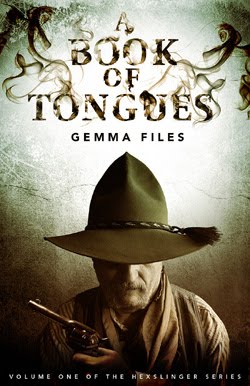
[Beyond the Wordcount] Gemma Files on Explicit Sexuality in "A Book of Tongues"

Do you wonder how a book is made? If you are an avid reader and the sight of a book makes you glow, then you probably have wondered about a novel’s journey from idea to hard/softcover delight on your local bookstore’s shelf. Did the author discover the story whole and intact? Did the story need countless revisions? How much is researched and how much is the product of the author’s imagination? What did the author have to go through to publish that novel you just love? Beyond the Wordcount is the feature that will give a behind-the-scene look to the story behind the story, the things that you will never guess as they stay off the pages.

BIO: Born in London, England and raised in Toronto, Canada, Gemma Files has been a film reviewer, teacher and screenwriter, and is currently a wife and mother. She is the author of two collections of short fiction (Kissing Carrion and The Worm in Every Heart, both from Prime Books) and two chapbooks of poetry. She also won the 1999 International Horror Guild Best Short Fiction award for her story “The Emperor’s Old Bones”.

Blurb:
Two years after the Civil War, Pinkerton agent Ed Morrow has gone undercover with one of the weird West's most dangerous outlaw gangs-the troop led by "Reverend" Asher Rook, ex-Confederate chaplain turned "hexslinger," and his notorious lieutenant (and lover) Chess Pargeter. Morrow's task: get close enough to map the extent of Rook's power, then bring that knowledge back to help Professor Joachim Asbury unlock the secrets of magic itself.

Magicians, cursed by their gift to a solitary and painful existence, have never been more than a footnote in history. But Rook, driven by desperation, has a plan to shatter the natural law that prevents hexes from cooperation, and change the face of the world-a plan sealed by an unholy marriage-oath with the goddess Ixchel, mother of all hanged men. To accomplish this, he must raise her bloodthirsty pantheon from its collective grave through sacrifice, destruction, and apotheosis.

Caught between a passel of dead gods and monsters, hexes galore, Rook's witchery, and the ruthless calculations of his own masters, Morrow's only real hope of survival lies with the man without whom Rook cannot succeed: Chess Pargeter himself. But Morrow and Chess will have to literally ride through Hell before the truth of Chess's fate comes clear-the doom written for him, and the entire world.

---

So: Harry kindly asked me to drop by and talk about my first novel, A Book of Tongues: Volume One of the Hexslinger Series. The short pitch is that it’s a Weird Western set in an alternate 1867 where it’s common knowledge that people sometimes randomly develop demigodlike magical powers--people like “Reverend” Asher E. Rook, for example, the infamous “hexslinger” who leads an outlaw gang co-captained by his volatile lover, Chess Pargeter, and once cursed an entire New Mexico town to salt. Add a conflicted undercover Pinkerton agent and a not-so-dead Mayan-Aztec goddess with a plan (Ixchel, the Rainbow Lady, Mother of Hanged Men) to the mix and it’s a party, for certain blood-soaked values of such.

Now, this being a Western, the book contains a fair deal of the usual gunfights, train-robbery, hanging out in houses of ill repute, sass-talking and riding at high speed from here to there, along with all the black magic shenanigans. Where it differs from other Westerns, however--excepting, perhaps, William S. Burroughs’ The Place of Dead Roads, whose title I shamelessly plundered for one particular plot-point--lies in its depiction of the central relationship between Reverend Rook and Chess, which I wanted from the get-go to be as passionate and explicit as possible: Just like any other big-R Romantic collision between two very-bad-for-each-other-everywhere-but-in-bed people usually is, except with two dudes. And going by reviews like these--

What a disappointment! Great premise, great writing, great characters. All completely overshadowed by a constant barrage of explicit sex scenes. I am baffled as to their purpose. I gave up about 40 pages from the end. I won't be reading the sequels. (“mystery lover”, at Amazon.com)

I have had to struggle through the authors repetitive gay sex scenes as I'm more interested in how the plot progesses. The two main characters, though told in part from a 3rd character, are gay (and/or bi) and have a stormy, rough relationship. I get that, ok, no worries -- but every few pages it seems they are engaging in rough sex. Now, a little of that to establish the nature of the relationship is ok, but it is used overly much and becomes a page-skipper for me. After all, the rear cover text doesn't say "Bang your way through the Old Weird West with hot gay action." (John Cunningham, aka “Mil-history fanboy”, at Amazon.com)

...the plot seemed exciting and had all the elements that I thought I might enjoy: magic, mystery, monsters and mayhem. Unfortunately there was one thing that held my enjoyment of the novel in check: sex. Lots and lots of sex... I found the sex in A Book of Tongues to be a major distraction from what amounts to a completely fascinating story full of horror and magic. (Mike, at King of the Nerds)

--I think I’ve succeeded in that aim.

Though it’d be easy to take the “I came out of Fandom, where it’s quasi-normal to write explicitly about sex!” stance, in my case, that’d be more than slightly disingenous; not only did my decade-long affair with writing fanfiction come very securely after I’d already become a published author, but it also came after I’d gained a weird little rep for writing stuff that was capable of literally icking the Powers That Be on Showtime’s The Hunger TV series out enough that they sometimes preferred to pay me for the use of my titles and make things up wholesale, rather than option the stuff that had actual sex in it and then (oh, I don’t know) use that actual sex in their supposedly sexy show. For them, I think, the main problem was that A) I kept putting horror in my Erotic Horror and B) often said eroticism was of not just the dude-on-chick/chick-on-chick variety, but also the dude-on-dude variety.

So why do this at all? Why alienate a prospective section of my audience--mainly, it seems, the core demographic to whom Westerns and horror/dark fantasy novels usually appeal, ie straight guys? Well, as the old saying goes, when I wrote this book, I was writing it for me; I was my audience, possibly the only one the book would ever have, which is why I filled it with things I enjoy. And one of the things I’ve always enjoyed is telling stories from a non-default perspective--making my main characters people who, in “regular” media, are rarely coded as protagonist material. Like Hal Duncan, I believe there should be queer characters of all types running through the mainstream narrative: Not just as adjuncts to the heterocentric “norm”, not de-sexed for our protection, but as full, functional, complex, conflicted human beings capable of full agency, from heroes to villains and everything in between.

After all, we’re already dealing with two guys of very questionable moral fibre indeed, from the get-go; Chess alone is, at base, a typical Billy the Kid/Jesse James bad-ass who kills because it’s easy and fun, a post-Civil War adrenaline junkie with an equally rotten attitude and temper, while the Rev is a smooth-talking hypocrite, a faithless preacher, a Bad Man with a Bible. So the fact that Chess is also a literal son-of-a-whore who hasn’t been above trading blowjobs for bullets, born small, pretty and outright queer in an ultra-macho world, should really just add a few more petals to the flower--I never wanted to be in the ridiculous position of saying he was bad because he was gay, or gay because he was bad. He’s simply one of those guys who doesn’t like to talk about his feelings, preferring to communicate far more directly, and the Rev responds in kind, like he’s the lit match to the Rev’s fuse; as with other toxic couples, their sexual interaction pulls them inexorably together, right up until it eventually tears them apart.

But it’s not all politics either, nice as that makes me sound, because I am also what the kids call a slasher--a woman (functionally straight, as it turns out) who is turned on, in a frankly fetishistic way, by the idea of gay male sex. Which isn’t to say that I’m not interested in anything else, as I think any cross-sampling of my shorter work would bear out--sex is one of the most primal motors around, an integral part of any writer’s paintbox, especially when you’re concentrating on a genre as literally visceral as horror. But after having spent the first twenty years of my life trying to explain this particular oddity of mine to other people and being stared at in fascinated revulsion, if you’d ever told my teenage self that one day there’d be so many women with the exact same kink writing porn on the Internet that it would become a bit of a cultural joke, I’d’ve laughed right in your face.

Now, I could talk all day, pretty much, about the innate heterocentrism of mainstream horror—point out that “mainstream” usual means “threat from outside disrupts normalcy, normalcy is restored”, and that heterosexuality is still assumed to be the default, for example. But then I’d probably get sidetracked into talking about how hilarious the very concept of “mainstream” horror really is, when horror’s already a ghetto inside a ghetto inside a ghetto. Or the dicey concept of Monster as Other, in which the inclusion of a non-default character in a narrative can be easily seen as Othering that character in order to evoke cheap thrills or squirms. These are all valid issues that make for equally valid sidebars, but I’m not going down any of them just right now.

Instead, let’s go back to the general idea of How Much is Too Much? How Far is Too Far? Which often, but not always, tends to blend into the sub-category of Why You Gotta Make Me Think of That? Ew, Ew, Ewwww!

I do believe that there are some narratives which call out for explicitness in sexual matters—narratives in which the sexual interaction of the characters is as least as plot- and character-important as any other sort. Catherynne M. Valente’s Palimpsest woud be a fine example of one of these, a story in which sex is a given, required, in order to get what the characters “really” want, which is entrance to the titular trans-dimensional city itself. The interesting slant this places on those sex-scenes is that they become entirely functional very quickly, and then shift once more when the characters form relationships with genuine emotional currents amongst themselves. In Piers Anthony’s Chaining the Lady, meanwhile, which has gender-issues aplenty (like all Anthony books, it’s somewhat obsessed by boobs and the prospect of “impregnation”), each of its many sex scenes forms an absolutely necessary point in the story as a whole; for these mainly alien creatures, sex is a way of communication, of exerting dominance, of facilitating transition. Or the Phaedre no Delaunay books, by Jacqueline Carey—they’re very securely about sex, because the main character is a sex worker whose gifts lie within the realm of diplomacy through S & M. Remove the sex, and though there would still be a plot, that plot becomes far less understandable.

Perhaps all of this comes back to what I used to call “and then the lamp went out” syndrome, something fairly rampant in historical fiction. In books like Mary Teresa Reynolds' Myself My Sepulchre, a re-telling of Nero’s reign from his own POV which casts him as a hapless victim, there’s a fair deal of sex of every conceivable type going on, but we’re not allowed to play through it blow by blow (so’s to speak)…at a certain point, sometimes fairly early on in the action, the lamp goes out, and we’re left to imagine the details for ourselves. This as opposed to Gore Vidal’s Caligula, which I read at a sadly early age, in which we do get the full monty, with choregraphy. Interestingly, this quickly becomes less titilating than oversatiated, boring and tragic, even without the lashings of murder piled on top. Yet it truly does seem necessary to take this particular funhouse tour, in order to understand the crazy world of privilege and power Caligula inhabits; as with the film it was based on, pornography is a poor categorization—a trick of the MPAA ratings system, like saying Behind the Green Door is literally “the same” as Henry and June.

In A Book of Tongues, I start out with a relationship between two equally screwed up people, one of whom literally defines himself via his sexuality. It’s become part of Chess Pargeter’s general bad-assery that he will indulge himself any way he wants with whomever he wants, and damn the consequences; in a way, it’s like Rook’s magic is for him—automatic, reflexive, increasingly easy. And as we learn more about the hexes themselves, my magician-characters, we discover that they’re drawn to parasite on each other, to suck each other’s power out in a vampiric manner than mimics and accellerates sexuality, re-framing Rook and Chess’s mutual obsession as something even more integral (and sinister).

In terms of the mechanics of the sex itself, my rubric was always character-based. Chess, perverse bastard that he is, likes to tweak other people’s expectations, and his liking to be on the bottom has become yet one more way to do that--but because he’s Chess, he’s also the toppiest bottom on the face of the earth. As he tells one character, it gives him a thrill to overpower larger guys with his willingness to submit; he’s basically shameless, so it’s not like he’s losing anything to be on the receiving end, and watching the conflict they go through in realizing that is part of his general orgasmic charge.

The Rev, on the other hand, is far more cerebral, and weirdly more equitable in his bedroom habits. What turns him on most is emotional intimacy--the idea that for Chess, who’s done everything you can think of with guys he could’ve cheerfully shot afterwards and not turned a hair, the Rev is the first and only person he’s ever really cared for. So how far can Rook go with that? The good part is that he genuinely enjoys causing Chess pleasure, but the bad part--the secret, increasingly gleeful part--is that he sometimes enjoys causing Chess pain, too. That he enjoys steering Chess around by the dick, the way Chess does so many other guys.

So yes, there’s a lot of sex in the book. From my POV, however, it was all necessary, and it could have been far “worse”. But I definitely enjoyed writing those scenes, and I suppose that comes across in a way that might well read as creepy depending on your mileage, or standards. Is the difference basically a matter of whether or not you feel like the author was enjoying his or herself a little “too much” while writing the scenes in question? If so, I’m stuck between a rock and a hard place; I can’t—won’t, I guess, more likely—deny that’s a strong component to my motivations, always.

Funnily enough, however, it’s been occurring to me lately that I may take some flack for there being substantially less sex in the next Hexslinger Series installment (A Rope of Thorns, out in May), but--a lot’s going on in that book, and they’re busy, you know? Things to do, places to go, wounds to recover from, apocalypses to avert. Plus far more world-building than I ever thought I’d signed up for, if you like that sort of thing...

I guess we’ll see.

Sunday, January 30, 2011

[Beyond the Wordcount] Blake Charlton on Worldbuilding Genesis

Do you wonder how a book is made? If you are an avid reader and the sight of a book makes you glow, then you probably have wondered about a novel’s journey from idea to hard/softcover delight on your local bookstore’s shelf. Did the author discover the story whole and intact? Did the story need countless revisions? How much is researched and how much is the product of the author’s imagination? What did the author have to go through to publish that novel you just love? Beyond the Wordcount is the feature that will give a behind-the-scene look to the story behind the story, the things that you will never guess as they stay off the pages.

BIO: Pursuing dual careers can be an exhausting, even haunting task. Devoting time to one craft is almost always accompanied by the sensation that the other craft is being neglected. The above quotations remind me why I bother to combine medicine and literature. At the root of both arts—when practiced correctly—is a transformation. From sickness to health, from ignorance to experience, from absence of feeling to wonder or awe or dread. Both arts are about expanding life, helping us become more rightly ourselves.

That might sound like lofty mumbo-jumbo coming from a guy who writes about wizards and dragons.

Blurb:

Imagine a world in which you could peel written words off a page and make them physically real. You might pick your teeth with a sentence fragment, protect yourself with defensive paragraphs, or thrust a sharply-worded sentence at an enemy’s throat.

Such a world is home to Nicodemus Weal, an apprentice at the wizardly academy of Starhaven. Because of how fast he can forge the magical runes that create spells, Nicodemus was thought to be the Halcyon, a powerful spellwright prophesied to prevent an event called the War of Disjunction, which would destroy all human language. There was only one problem: Nicodemus couldn’t spell.

Runes must be placed in the correct order to create a spell. Deviation results in a “misspell”—a flawed text that behaves in an erratic, sometimes lethal, manner. And Nicodemus has a disability, called cacography, that causes him to misspell texts simply by touching them.

Now twenty-five, Nicodemus lives in the aftermath of failing to fulfill prophecy. He finds solace only in reading knightly romances and in the teachings of Magister Shannon, an old blind wizard who’s left academic politics to care for Starhaven’s disabled students.

But when a powerful wizard is murdered with a misspell, Shannon and Nicodemus becomes the primary suspects. Proving their innocence becomes harder when the murderer begins killing male cacographers one by one…and all evidence suggests that Nicodemus will be next. Hunted by both investigators and a hidden killer, Shannon and Nicodemus must race to discover the truth about the murders, the nature of magic, and themselves.


The Task: Ever the worldbuilding nutjob I poked Blake Charlton to explain [yet again] how his world emerged and as nice as he is, he complied. So here it is kiddos. Enjoy.

---

As a junior in college, I was the only learning disabled student I knew and semi-terrified that I was an admission mistake. I also was painfully earnest about cultivating the “life of the mind.” The previous summer, I had revisited the first books I had read by myself, fantasies all of them. So the genre was in the back of my mind, but I wasn’t searching for an epic idea. It just happened.

Specifically, it just happened in a boring English Literature seminar on Shakespearian tragedy and ancient Greek tragedy. Fascinating syllabus, underwhelming lecture. I was jotting down notes. Back then, I still wrote mostly in a phonetic script, especially for words I had never seen spelled. For example, I might write the word “onomatopoeia” as “onohmonohpeeah.” Next to me sat another junior with whom I had something of a rivalry. We had taken several English classes together and often butted heads about interpretations. I both disliked and grudgingly respected him. At this particular moment, he had stopped listening to the lecture and was eyeing my notes.

“Wow,” he whispered while tapping on my phonetic shorthand, “you really did ride the short bus to school.”

I said something inane like “Tell me about it,” when in my mind I had this image of pulling my misspelled words off the page and using them like a boxing glove to punch him in the face.

I was still steaming after class as I walked back to my residential college. It was a beautiful dark, late-autumn day: the first snow of the year seems only moments away. Yale was built in imitation of Oxford and Cambridge: gothic arches, stone spires, the whole bit. My residential college, Trumbull College is particularly beautiful, abutting the large stain glass windows of Sterling Memorial Library. I found myself wandering around Trumbull’s neo-gothic courtyards and dreaming of clubbing my rival with physically real sentences. In particular, I paced the Potty Court: a stone courtyard that houses a semi-famous stone gargoyle sitting on a toilet.

Suddenly, the idea for Spellwright bloomed in my imagination. In a world where written language could be made physically real, universities would be vitally important. They might have even more spectacular gothic architecture and living gargoyles. In this world, authors would be terribly powerful and, because words had to be physically created, their muscles would be as important as their brains. And of course, being dyslexic would be really, really dangerous. How then would the magic spells behave? At the time I was also studying biochemistry, specifically how the language of DNA made proteins that affect the physical world. I decided that magical language would behave like organic macromolecules: it would have to fold into a correct conformation to become effective.

About an hour later, I had an outline for a young spellwright whose touch caused any text to misspell. Turning that into a novel, however, took eight more years; this is mostly because an interesting basis for a magic system doesn’t make an interesting novel. There’s a lot to consider when world building around magic (one must consider limits to magical power, its effects on society, etc). It took me a while to figure all of that out for myself.

Sunday, November 28, 2010

[Beyond the Wordcount] Chris Evans on Historical Accuracy

Do you wonder how a book is made? If you are an avid reader and the sight of a book makes you glow, then you probably have wondered about a novel’s journey from idea to hard/softcover delight on your local bookstore’s shelf. Did the author discover the story whole and intact? Did the story need countless revisions? How much is researched and how much is the product of the author’s imagination? What did the author have to go through to publish that novel you just love? Beyond the Wordcount is the feature that will give a behind-the-scene look to the story behind the story, the things that you will never guess as they stay off the pages.

In this installment I have invited author Chris Evans, who penned the wonderfully entertaining Iron Elves series. I utterly enjoyed A Darkness Forged in Fire [REVIEW] and The Light of Burning Shadows [REVIEW] for their adventurous charm as well as uncharacteristic for epic fantasy world.

Bio: CHRIS EVANS was born in Toronto, Canada and now lives in New York City. He’s earned degrees in English/History, Political Science, and a Masters in History with Distinction specializing in military history. Before moving to the U.S. he was a military historian and conducted battlefield tours of Europe in addition to being the military historical consultant on a television documentary on the First World War. Chris started his commercial publishing career as an editor with Ballantine/Del Rey of Random House and is currently the editor of history and current affairs/conflicts books at Stackpole Books where he launched the Stackpole Military History Series which now has over 120 titles in print.

Blurb:

Konowa Swift Dragon, former commander of the Empire's elite Iron Elves, is looked upon as anything but ordinary. He's murdered a Viceroy, been court-martialed, seen his beloved regiment disbanded, and finally been banished in disgrace to the one place he despises the most -- the forest.

Now, all he wants is to be left alone with his misery...but for Konowa, nothing is ever that simple. The mysterious and alluring Visyna Tekoy, the highborn daughter of an elfkynan governor, seeks him out in the dangerous wild with a royal decree that he resume his commission as an officer in Her Majesty's Imperial Army, effective immediately.

For in the east, a falling Red Star heralds the return of a magic long vanished from the earth. Rebellion grows within the Empire as a frantic race to reach the Star unfolds. It is a chance for Konowa to redeem himself -- even if the entire affair appears doomed to be a suicide mission...


and that the soldiers recruited for the task are not at all what he expects. And worse, his key adversary in the perilous race for the Star is the dreaded Shadow Monarch -- a legendary elf-witch whose machinations for absolute domination spread deeper than Konowa could ever imagine....

Task: Since I am a worldbuilding junkie I wanted to know the following. To what degree did you use the historical accounts about the Napoleonic era in your world and where did you decide to fashion that period into something more fantastic?

---

I think historians and authors share many traits, not the least of which is something I call the 100 to 1 ratio. Basically, it means that for every 100 hours of research you wind up with about a page of material that goes in the book. OK, the ratio isn’t always that extreme, but it often feels like it is. The disparity between the volume of research I conduct and what ultimately winds up in the book is usually a product of my fascination with a topic once I start to delve into it. I’m just naturally curious. Even if I’ve found my answer I often read on, curious to see what else I might discover, or simple to finish the chapter or article and learn something new.

Writing the Iron Elves has definitely been a learning experience. I specialize in 20th century conflicts, but the series is inspired in large part by the Napoleonic Wars, and to a lesser extent Victorian England and the American Civil War. As I’m not writing historical fantasy, but rather fantasy inspired and informed by history, I have the leeway to incorporate bits and pieces and craft them into something new in my world. It’s a lot of fun and also challenging. The key question when I write is does it make sense for the world I’ve created.

The experience of the soldier throughout history is universal in many respects. Weapons and tactics have changed over the centuries, but the basic experience of the infantryman, and now woman, has remained fairly constant. I focused mostly on memoirs from the Napoleonic era in order to get that period feel. I wanted to know what black powder tastes like and what they used to polish their boots. I studied period manuals on tactics covering everything from cavalry charges to the famous British square. I read up on Napleon’s expedition to Egypt in order to get a sense of fighting in the desert. More books were devoured on Waterloo, young Wellington in India, the fighting in Portugal and Spain, recipe books from the late 1700s, social studies of life in London, Paris, and other European cities during that time, and Napoleon’s foray into Russia and the disastrous retreat that followed.

With all that research in hand I then consulted with some of my authors who happen to be combat vets from WWII, Korea, Vietnam, and Iraq and Afghanistan. They gave me more insight into the sights, the smells, the privations, and the overall feel of being in harm’s way. One of the reasons I decided to write the Iron Elves was my desire to show an epic fantasy adventure from the regular soldier’s perspective. We’ve read so many stories that focus on farm boys who become kings and intrepid bands of traveling heroes that it seemed to me the plight of the common soldier wasn’t really being acknowledged very much.

So with all this research in hand the question becomes how to use it? The answer, at least for me, is sparingly. One or two well-placed details can hint at a whole world beyond them. First and foremost the story has to move. The danger in doing all that research is the desire to show it all in the novel, but to do that is to turn a story into a reference book. I didn’t set out to write a series on Napoleonic warfare, so I’m not going to dump tons of research into the novel on the different caliber muskets or the myriad types of uniforms and what each bit of braid and color signified. I write more in terms of directing a movie. I see the shot, then write it for the reader, giving them a few clear places to focus which I hope creates enough of an image that their imagination is able to fill in the rest.

As the series is fantasy the question of how magic is integrated into the story is equally key. One of the core realities of all war that I hadn’t seen covered very much in fantasy was the condition now known as Post Traumatic Stress Disorder, PTSD. In previous wars it was called Battle Exhaustion, Shell Shock, Lack of Moral Fiber, and too often, and incorrectly, cowardice. Through the use of a magical oath binding the soldiers of the Iron Elves to the regiment even after death I was able to illustrate this condition by having the survivors literally having to carry with them the shades of their fallen comrades. It’s dark, and at times disturbing, but that’s the experience of war and that’s what I wanted to bring to a fantasy. Of course, just like in real life, soldiers find ways to combat these feelings and one of the most effective is comradeship and laughter. I read numerous accounts of soldiers finding humor in even the darkest of situations and realized I could weave that into the series and hopefully create a balanced and exciting take on the traditional epic fantasy adventure.

Cheers,
Chris Evans

Sunday, November 21, 2010

[Beyond the Wordcount] Lauren Beukes on The History of Violence

Do you wonder how a book is made? If you are an avid reader and the sight of a book makes you glow, then you probably have wondered about a novel’s journey from idea to hard/softcover delight on your local bookstore’s shelf. Did the author discover the story whole and intact? Did the story need countless revisions? How much is researched and how much is the product of the author’s imagination? What did the author have to go through to publish that novel you just love? Beyond the Wordcount is the feature that will give a behind-the-scene look to the story behind the story, the things that you will never guess as they stay off the pages.

In this installment, I bring you Lauren Beukes, author of Zoo City [which I will review as it happens in December]. Her post will be connected with this title, which has been highly praised all around.

Bio: Lauren Beukes is a recovering journalist, TV scriptwriter, award-winning columnist and writer (aka glorified typist). She’s the author of the muti noir, Zoo City released in 2010 and the dystopian thriller Moxyland (2008) which William Gibson describes as “very, *very* good. Her short stories have been published in various anthologies, including Home Away: 24 Hours. 24 Writers. 24 Places, Touch: Stories of Contact, Open, FAB, African Road: New Writing from Southern Africa, 180 Degrees, Urban 03 and Novel Idea.

She has an MA in Creative Writing from UCT, but she got her real education from 12 years of freelance journalism. Writing for the likes of the Sunday Times, Colors, The Hollywood Reporter, Nature Medicine, Marie Claire, and The Big Issue, among others, she picked up really useful life-skills like sky-diving, pole-dancing and brewing mqombothi. Journalism also allowed her to hang out with AIDS activists, township vigilantes, electricity thieves, homeless sex workers, teen vampires, reluctant basejumpers and other interesting folk.

Blurb:

Zinzi has a talent for finding lost things.

To save herself, she's got to find the hardest thing of all: The truth.


Task: When I contacted Lauren to contribute to my feature, I had the clear idea to ask her about the inclusion of additional materials such as articles, interviews and news reports. I had no idea that Lauren had something way better in mind. Namely, the history and importance of violence in Zoo City.

---

Zoo City is a muti noir *– and noir, by necessity, includes acts of violence. There has to be a body involved. Luckily, I’ve got several. But, for the most part, that violence is restrained.

Zinzi, is not your typical Buffy-model kick-ass urban fantasy heroine. That is to say, she’s not holding off hordes of slavering undead loup garou ninjas with a Hello Kitty chainsaw in one hand and a fireball in the other (although that does sound pretty awesome and I may have to write that).

In fact, just about the worst thing that Zinzi has to confront (apart from her past and the really horrible thing later) is a bunch of street kids armed with a sharpened rusty screwdriver. A situation she handles very un-heroically by running away. And that’s because a rusty screwdriver is a helluva thing. Worse than zombie werewolf claws.

The novel is set the reality of Johannesburg’s inner city slums with derelict buildings and refugees and crime and poverty and ordinary people trying to get by in awful conditions. And that also meant writing violence that was real - because it’s an everyday occurrence in South Africa with far-reaching impact way beyond fiction.

Just how everyday was brought home when several synchronicities cropped up very close to me in the real world that horribly echoed events in the novel.

I try to avoid spoilers, but I can tell you that Zoo City includes, in no particular order, a fire, a drowning and a stabbing.

In March, while I was finessing the last chapters, my brother-in-law’s farm in the mountains practically burned to the ground. The aftermath was like a scene from The Road, which I was reading at the time, an ashen landscape, blasted trees. And worse, ruined livelihoods. Insurance doesn’t cover farmers for forces of nature.

Then, as we were going over the final proofs, a friend of my editor’s drowned in a freak accident. A well-known, well-liked professor who was tubing in a river in the wilderness with his family. He fell off. He never resurfaced. His family had to hike for hours to find cell phone reception to call for help. They found his body three weeks later. It had been trapped underwater, wedged beneath a rock ledge by the currents. My editor struggled to deal with the similar scene in the book.

There were also two stabbings with a direct link to me that happened while I was writing the novel. My dad was witness to the one. He was out one morning walking his dogs near the beach. He passed by a group of women walking to work at the nearby hotel. A man confronted one of the women. There was an argument. Then the man pulled out a knife and punched it into her stomach repeatedly.

My dad yelled, alerting a group of construction workers who chased after the man with pickaxes and shovels. They chased him onto the beach. He ran into the waves. They stood on shore, waiting for him to come out. He floated away, deeper and deeper out to sea. Eventually, he drowned. His body washed up on shore a few days later. The woman recovered. Eventually. Slowly. Painfully. As much as you can.

The other stabbing was far closer to home. Tomokazie, the daughter of the woman who cleans for me once a week had a fight with her abusive boyfriend, Sonwabo. He stabbed her in the thighs and buttocks and poured boiling water over her head and back, then locked her in his house and walked away. The neighbours finally called the cops five days later, alerted by the terrible smell, by the groaning. The police broke down the door. The flies were thick on her skin. But she was still alive. She was rushed to the burns unit at the nearest hospital. It took her four months to die. Third degree burns will do that. Infection sets in deep. She was in agony most of the time, unable to walk, barely able to get out of bed.

The night before she died, Tomo’s sister saw Sonwabo lurking outside their house, because the cops hadn’t bothered to arrest him. He was hiding in the yard, crouched under the window. Tomo was so frightened that she soiled herself. She passed away the next morning, in the waiting room of Somerset Hospital.

Some of what happens in Zoo City is over-the-top. It’s gruesome. It’s shocking. It’s very nasty.

It’s meant to be.

I tried to do it in a way that wasn’t gratuitous, that respected what real violence is and what it does to us. There’s a balance to writing fiction that is entertaining but still keeps it integrity.

Real violence is not the villainous puppet master forcing someone to gouge their own eyeball out with an ice-cream scoop and eat it or the hillbilly psychos torturing and raping and gutting the hapless campers and parading around afterwards in their skins or even the cock-shock stupidity of human-centipeding.

It’s a girl in agony shitting the bed because the man who did this to her is still free to do it again.

* magic

Sunday, October 31, 2010

[Beyond the Wordcount] Paul Jessup on Collaborating with an Artist


Do you wonder how a book is made? If you are an avid reader and the sight of a book makes you glow, then you probably have wondered about a novel’s journey from idea to hard/softcover delight on your local bookstore’s shelf. Did the author discover the story whole and intact? Did the story need countless revisions? How much is researched and how much is the product of the author’s imagination? What did the author have to go through to publish that novel you just love? Beyond the Wordcount is the feature that will give a behind-the-scene look to the story behind the story, the things that you will never guess as they stay off the pages.

In this installment of Beyond the Wordcount is Paul Jessup, of whom I had the pleasure of reading his short story collection Glass Coffin Girls, an eclectic mix of weirdness, madness and a bit of beautiful absurdity. He also penned the highly praised Werewolves, which will be the topic of his post.

Bio: Paul Jessup is a weird writer, who has lived his entire life on the haunted shores of Lake Erie. He dabbles in many genres, with Urban Fantasy and Steampunk being his two current favorites. He has three books out currently, with a fourth on the way. Open Your Eyes is a surreal space opera, published in 2009 by Apex Books. Glass Coffin Girls is a collection of short stories, published in 2009 by PS Publishing. Werewolves is an illustrated book published in 2010 by Chronicle Books and illustrated by Allyson Haller. In Autumn/Winter 2010 The Zombie Feed (an imprint of Apex Books) will publish his short zombie novel Dead Stay Dead.

Blurb:

Werewolves takes the form of an illustrated journal that plunges readers into the life of a high school girl-turned-werewolf as she makes her transformation. After Alice and her brother are bitten by what they assume are large dogs, her journal/sketchbook becomes a place for her to record the changes they start to experience her socially awkward brother falls in with some creepy new friends, and she surprises herself with new strengths and instincts and a suddenly nonvegetarian interest in raw steak.
Task: I asked Paul to write of his experience working with an artist in order to produce an illustrated book. The process as you will learn is very interesting, albeit complicated.

---

The process for doing my new book Werewolves was a fairly interesting one. I didn’t work directly with the artist, instead we worked out what we wanted to do with the story first, plot wise. Then started working on a way to tell this as visually as possible. I needed to come up with something that would inspire an interesting visual image on every single page, which was very difficult.

Not only did I have to do a diary entry per each page, but each diary entry had to be self contained, interesting as text, and contain a cool image. This got to be challenging, knowing how much to be into a section, what to leave out. How to get the plot across in a diary format without it being stiff and wooden.

I rewrote entire sections over and over again, trying to get the right emotional pitch, the right level of information, and trying to move the plot in gently and not dumping it all across the page.
I also had to refrain from detailed descriptions in the work itself, and I had to divorce the text from directly stating things that would be better off shown in the image itself. So the text had to be less description, more sounds smells and internal thoughts.

When we were done with the text I know that they picked an artist that fit the tone of the work itself, and wanted to bring in someone that not only reflected the way the character talked, but also got the high school journal feeling down pat.

I didn’t actually see any of the final art until after the novel was ready and rolling toward publication. So I had no idea what to expect at all. But I must say, the final product looked fantastic. I didn’t really have any input into the artist at all, I mostly just came up with basic ideas, notes, stuff that could work as sketches. It was interesting to see which ones the artist (Allyson Haller) used, and which ones she discarded. I could see why she used the ones she did, since some suggestions probably wouldn’t be as striking or as interesting as the ones she came up with.

All and all, it was an interesting experience. One I’d definitely do again.

Sunday, October 17, 2010

[Beyond the Wordcount] From Self-Published to Traditionally-Published by Todd Newton

Do you wonder how a book is made? If you are an avid reader and the sight of a book makes you glow, then you probably have wondered about a novel’s journey from idea to hard/softcover delight on your local bookstore’s shelf. Did the author discover the story whole and intact? Did the story need countless revisions? How much is researched and how much is the product of the author’s imagination? What did the author have to go through to publish that novel you just love? Beyond the Wordcount is the feature that will give a behind-the-scene look to the story behind the story, the things that you will never guess as they stay off the pages.

This week my guest is Todd Newton, author of The Ninth Avatar, which has gone through two prints already. First as a self-published novel and then as a traditionally published novel. It’s no secret that I didn’t receive the self-published edition very well [review], pointing out that there is potential in the book, but only after extensive editing. Now, I do have the edited and revised book, which I hope to review soon.

Bio: I was born in 1980, had an interesting upbringing (as I'm sure we all have), and rebelled as a teenager. I have since realized I was not the only person to do this (hence previous the parenthetical statement). After ten tumultuous years I barely remember, I moved to Denver, Colorado. Things have been different ever since.

Blurb:

When the slain march, prophecy will be fulfilled. The Ninth Avatar is coming. Wizards have wondered for generations when a human would ascend to become the Ninth Avatar, and what would happen when they did. Opinions differ, but the Ninth Pillar of Magic--that of Darkness--is feared by many whether they use magic or not. When Starka, an outcast priestess of the magic loathing Cathedrals of Myst, receives a prophecy heralding this ascension, a new force rises to threaten the entire known world. The Carrion army, a race of transformed humans bearing black horns and an unquenchable thirst for blood, destroys every city it comes across. Their leader, Zion, has only one goal: to become the living embodiment of magic that is the Ninth Avatar. Aiding Starka in her quest to halt this are DaVille, a mysterious warrior bent on killing the Carrion leader; Cairos, a wizard from the betrayed city of Illiadora; and Wan Du and Lady Mayrah, a man and woman from rival nations now decimated by the Carrion. Amidst all this turmoil, Wadam, a Cardinal of Starka's faith, seeks to seize control of Myst for himself and thereby subjugate the female leaders. With the world in peril Starka must find the means to prevent these things, or die trying.


The Task: I have asked Todd to tell me of his journey from the scorned self-published ‘author’ to a traditionally published one [and I put those quotation marks in jest]. What I received from Todd was his journey with The Ninth Avatar from its genesis to long path to publication.

---

The stigma of self-publishing may always exist, no matter how rational or logical of an argument you post on your blog. It is nigh on impossible to get attention (and, therefore, readers) for your self-published book. This is because the responsibility to create a quality product rests on the author’s shoulders, rather than someone with deeper pockets or a higher headcount. Frankly, if you’re not already well-known, no one has any reason to trust you.

The Ninth Avatar began as a plot for a “garage” video game project. Its first iteration was a meandering “story summary” lacking just about everything a real story needs. Many years and a lot of work later, I had a coherent and thoroughly-edited novel manuscript staring at me from the other side of the computer screen. I also had a stack of query rejections from agents and various publishers.

This is not a unique scenario, but neither is it one for which there are any easy answers. The obvious question was what to do next, and all the searching and reading I did led me nowhere. I knew I wanted to write more books, even had a second one well underway, but I had no idea what to do with this completed novel.

With the intention of “getting my name out there,” I self-published The Ninth Avatar through CreateSpace, Amazon’s Publish On Demand (POD) offering. This was a tremendous learning experience for me as far as book/cover design, manuscript formatting, and “copy” writing because I had to do it all myself. CreateSpace provided an Amazon page, which was advantageous, but my original goal still seemed beyond reach.

At the end of the day, the challenge of “how do I sell the book?” remained. Even blog-based book reviewers are loath to touch self-published books, and I know because I contacted many of them directly. Getting a reviewer to read a book (any book) is like asking someone to do a bit of overtime after working a double shift; it’s not that they don’t care, but rather that they already have a stack of titles begging for their attention. For readers it’s much the same, except that they carry no obligations toward books. Merely preferences.

So it went until my book had been available for about two months. A fellow writer informed me of Trapdoor Books, a new startup publisher based locally. I contacted the man in charge, sent him a copy of my book and, after some debate and discussion, Trapdoor acquired it to publish. Finally, I would have something larger than me to add credibility to my campaign.

The process The Ninth Avatar (and I) went through with Trapdoor could not have been more different than self-publishing. The contract and money, for starters, were new. I had no agent, so the process was quite streamlined. Of course, when the work truly began I was lucky enough to be involved in certain decisions such as the map, manuscript edits, cover art, etc. I’m told by many other authors, especially debut authors, that their hands are pried off the wheel at this point.

Regardless, the responsibility no longer sat fully on my shoulders. I was an employee now, rather than the owner & operator of The Ninth Avatar, Inc. I had someone to ask when I had questions or concerns, someone who knew the answers and solutions. I was no longer running the marathon with only a cheering section to back me up.

Of all the differences, the largest was working with others. An Editor, someone paid to read manuscripts and provide suggestions to improve them. A Book Designer, someone paid to know how to make the text look good on the page, and care about the resolution of cover images. A Publisher, someone as invested as I was, and who wanted to see my book succeed.

Eventually, the book was released with a new cover and design treatment as well as numerous edits to the text itself. Its success, of course, still relies upon all of you. It’s been a long journey, and The Ninth Avatar and I still have a quite a bit further to go.

Sunday, September 26, 2010

[Beyond the Wordcount] The Genesis of 'Angel of Death'


Do you wonder how a book is made? If you are an avid reader and the sight of a book makes you glow, then you probably have wondered about a novel’s journey from idea to hard/softcover delight on your local bookstore’s shelf. Did the author discover the story whole and intact? Did the story need countless revisions? How much is researched and how much is the product of the author’s imagination? What did the author have to go through to publish that novel you just love? Beyond the Wordcount is the feature that will give a behind-the-scene look to the story behind the story, the things that you will never guess as they stay off the pages.

This week’s guest is J. Robert King. He is the author of one my favorite novels Angel of Death [Review],which impressed me with its realistic depiction of a monster. If you think American Psycho was frightening, because Patrick Bateman could very well exist, than the Angel in King's novel will stop your pulse with his sound logic.

Bio: J. Robert King is the award-winning author of over twenty novels, most recently The Shadow of Reichenbach Falls and the Mad Merlin trilogy. Fifteen years ago, Rob founded the Alliterates, a cabal of writers in the Midwest and West Coast of the U.S. Rob also often takes to the stage, starring in local productions such as The Complete Works of William Shakespeare (Abridged) and Arsenic and Old Lace. He lives in Wisconsin with his lovely wife, three brilliant sons, and three less-than brilliant cats.

Blurb:
The angel of death in Chicago oversees all people in the megalopolis, making sure their deaths fit their lives. Though most deaths naturally do, those that result from serial murder do not, so the angel spends much time trailing a serial killer in his patch.

On the trail of one such man, he encounters a cop and falls in love with her. When he is assigned to kill her, though, he has to make a choice between divinity and humanity.


The Task: I asked Robert to write a post detailing he created his character and pieced the psyche of a sociopath-monster. What I received exceeded my expectations. King not only answered my question about Azrael, but also presented a genesis for his novel.

---

People wonder where Angel of Death came from. It is, after all, a dark book.

Well, the quick explanation is that the book I'd written before it had been rejected by multiple publishers, and I was pissed off and wanted to write a pissed-off book. That's the quick explanation, and it's the truth, but it's not the whole truth.

Let's look at the elements of Angel of Death. First, of course, there's an angel, a servant of God who is charged to kill us. If this angel were human, he would be a serial killer. It is his very divinity that makes his actions right and good. Were this angel to lose his divinity and become human, quiet suddenly the work he has been mandated to do becomes the most monstrous act imaginable.

So, if God tells you to do it, you are justified in doing it, right?

Think about suicide bombers, sixteen-year-old kids from slums blowing themselves up. We think this is horrific, but the bombers do not, nor the men who strap explosives to them, nor the mothers who mourn them as holy martyrs. All of these people know that God wants sixteen-year-old boys to have their bodies ripped apart and have their bones fly as shrapnel to rip apart others.

Sin is disobedience to God, so if God wants you to kill yourself, then living is sin. If God wants you to kill the other passengers on the commuter train, then sparing them is sin. If God wants an old man to take his only son up to a mountain and ram a knife into the boy's heart, the old man is not a murderer but a saint.

That is, in part, what Angel of Death is. It's an exploration of the terrifying and grotesque nature of faith that justifies such atrocities.

Of course, to pull off a novel like this, I had to do a lot of reading about actual serial killers-- peering into their psyches, studying their crimes, watching them do what they did to their victims. I was appalled. I could not have imagined such depravity. What human beings are capable of doing to each other beggars the mind. I had launched this book to rail against God but found human crimes to be equally horrendous. Just when I was about to nail God to the wall, I discovered I had to nail myself there, too, and every other human being.

Like I said, this book came from a pretty dark place.

So, I started to write. At first, it was just me and the angel, wrestling. But I knew I wouldn't win a match like that. I brought in Donna Leland to distract the angel so that maybe I could escape. She was the good human there trapped between me and my monster. And the novel just unfolded that way. I didn't so much write it but chronicle it, observing with a kind of sick terror as Donna struggled to understand and then to love and then to escape Azrael.

I hid behind Donna, hoping she could save us both.

All right, so you know two thirds of the story, the railing against God and the railing against humanity. But the third part of Angel of Death—the part that makes it especially unsettling to my family and friends—is that I put all of them in it. I set the scenes in the town where I live and the town where I grew up and even the flood-prone Methodist campground where I spent many summers as a youth. The angel kills a young couple driving through Chicago on their way to Disney World on their honeymoon—a precise description of my wife and I when first we were married. The angel kills Mr. Strange, a garbage man in my hometown who was reprimanded for stalking my little sister. The angel kills all sorts of people I know, but mostly kills me in different phases of life.

Over and over, that angel is killing me. It was the one way I could escape him. Let him kill me again.

Yes, Angel of Death came from a really dark place.

It's a furious book, a murderous book, and I'm glad it is on paper now instead of in my mind. Of course, if the Angel of Death has his way, this book will somehow still be the death of me.

We'll see.

Sunday, September 12, 2010

[Beyond the Wordcount] Kaaron Warren on Botanica


This Sunday a new feature debuts on Temple Library Reviews. I had the idea back during my hiatus, when I thought I wanted more [because I do always want more in any regard] from the authors I enjoyed. I wanted an insider on how novels are created. I also realize how much effort, research and inspiration is involved behind a novel-length work, which is there on the pages, but the reader, well at least the average reader, doesn’t see how the wonders are created. What the reader sees are the pages and the words. So my intention is to take the reader beyond the wordcount and introduce him to the authors’ adventures in the land of writing, research and publishing.

My first guest is a personal favorite of mine, Kaaron Warren, whom I asked to write on the creation of the island named Botanica from her novel Walking the Tree [review by me to follow next month]. If you follow Kaaron around the Interwebs, then you will know that Botanica was inspired during her stay on Fiji and this is exactly this story that I wanted to learn.

---

My novel, Walking the Tree tells the story of the people who live on Botanica, a large island almost completely filled with an ancient tree.

I live in Australia, and while I’ve spent many days at the coast in my life, this is not the same as living on an island. You couldn’t walk around Australia, unless you had half a lifetime.

So when we found out we were moving to Fiji for three years, I knew that this would help me write the book. It would give me an understanding of what it’s like to live on an island, and what it’s like to circumnavigate that island.

We stayed on a number of small islands while we were there. Our favourites are the less ‘multi-national’ type ones, like Cagalai (pronounced Thangali), Leleuvia and Naigani (pronounced Naingani). The first two were easily circumnavigated, and there is something very fulfilling about walking the whole way around an island.

Pretty islands

I used this feeling in the novel. Most of the young women who set out from their home communities in Walking the Tree stop along the way, and make a new home. They live there for many years but then many of them are compelled to walk back to their birth communities.

I already knew I wanted this to occur, thinking about the many people around the world who live elsewhere but then feel a great desire for ‘home’ after many years. But circling those islands gave me a sense of how it feels to complete the circle, and how it would feel not to complete that circle.

Whenever we stayed on an island I took many photos and notes of how the water looked, the sand, the vegetation. I felt the sense of isolation and I understood that the people who live on the islands are not often compelled to leave. Again, it’s the sense of completeness, of being whole, you feel when you live in such a place.

One experience I had which made it, mood-wise, into the novel, was the time I was abandoned for less than 30 minutes.

We’d gone out to the deep sea for snorkeling. It was a small boat, with about 15 passengers. The boat dropped us variously about the place, and we drifted, and the boat drifted too. At one stage, I felt that even if I called, he wouldn’t hear me.

But he knew what he was doing, and we were all collected.

The Boats

On the way back, he stopped to let us climb onto a very small island, maybe 100 metres in diameter. I think he said there had been families living here once and there was small evidence of that; some rusty tin cans, a deeper hole right in the centre of the island. My friend and I, fascinated, looked in detail at the things left behind, as did another couple of people.

When we looked up, we were the only ones still on the island.

The boat was taking off with everybody else on board.

“We’ll come back,” the driver called. One man onboard held up a fishing line.

“Fishing!” he said, which explained nothing.

The Deserted Island

There was no shelter on the island; none at all. We had water bottles, which were almost empty. There was no vegetation bar some stringy bushes. It was really, really hot.

The four of us sank into the water to keep cool, and we kept calm by talking about how we would build a fire, how we’d catch fish, how we’d find water, if, you know, this was real and we had been abandoned.

It was 30 minutes before they returned. The arrogant fisherman had nothing, which meant we had to drive slowly home for him to find fish. We were sunburnt and thirsty.

That experience, that sense that I was alone and that there was nothing else in the world; that, I used in the book as well.
Related Posts with Thumbnails